Biokin’s Iza-Bren Shows Activity in Previously Treated EGFR-Mutated Lung Cancer, Supports Global Registrational Dose
Biokin’s U.S. subsidiary SystImmune has reported new global Phase 1 results for iza-bren, its EGFR×HER3 bispecific antibody-drug conjugate (ADC), supporting selection of a dose for registrational testing in patients with previously treated EGFR-mutated non-small-cell lung cancer.
At the selected 2.5 mg/kg dose, iza-bren produced an objective response rate of 33.3%, a confirmed response rate of 29.6% and median progression-free survival of 6.9 months. All patients had experienced disease progression on a third-generation EGFR tyrosine kinase inhibitor, and most had also received platinum-based chemotherapy.
The findings were featured in presentation OA10.01 at the 2026 World Conference on Lung Cancer in Seoul. In its conference announcement, SystImmune said the combined efficacy, safety and pharmacokinetic findings supported 2.5 mg/kg on days 1 and 8 of a three-week cycle as the recommended Phase 3 dose.
The results provide a clearer basis for advancing the drug, although a larger controlled trial will be needed to establish how it compares with chemotherapy.
Activity after multiple prior treatments
The randomized dose-expansion cohort of the global Phase 1 study evaluated three intravenous doses: 1.5, 2.0 and 2.5 mg/kg, administered on days 1 and 8 every three weeks.
At the February 9, 2026 cutoff, 80 patients had been randomized: 26 to the lowest dose and 27 to each of the two higher doses. Patients had received a median of two previous treatment lines, ranging from one to seven. All had progressed on a third-generation EGFR inhibitor; approximately 64% had received platinum chemotherapy and 18% had received amivantamab.
The supplied abstract results showed:
| Efficacy measure | All doses, 80 patients | 2.5 mg/kg, 27 patients |
|---|---|---|
| Objective response rate | 28.8% | 33.3% |
| Confirmed objective response rate | 23.8% | 29.6% |
| Median progression-free survival | 5.4 months | 6.9 months |
Results reflect the February 9, 2026 dataset.
The confirmed response rate is the more conservative measure because it requires tumor responses to be verified on a subsequent assessment. At 2.5 mg/kg, it corresponds to eight confirmed responders among 27 patients.
That activity is encouraging in a previously treated population. Nevertheless, the small dose groups limit the precision of the estimates. Randomization between doses helps inform dose selection, but does not establish superiority over another treatment.
Blood-related toxicity remains the main safety consideration
All participants received mandatory primary prophylaxis with granulocyte colony-stimulating factor, or G-CSF, to support neutrophil recovery.
In the February dataset, grade 3 or higher treatment-related adverse events occurred in 47.5% of patients across doses. One patient discontinued treatment because of a treatment-related adverse event, and no treatment-related deaths were reported.
The most frequent severe events were hematologic:
| Grade ≥3 treatment-related adverse event | All doses | 2.5 mg/kg |
|---|---|---|
| Anemia | 21.3% | 29.6% |
| Neutropenia | 20.0% | 29.6% |
| Thrombocytopenia | 5.0% | 7.4% |
Severe nausea, fatigue and hypokalemia each occurred in 2.5% of patients across doses. Investigators also reported one case of neutropenic fever and two cases of pneumonitis, one grade 3 and one grade 4.
The findings underline the importance of supportive care and pulmonary monitoring as development advances. Although the reported hematologic toxicity was lower than in earlier experience, the study did not randomize patients to receive or forgo G-CSF. Its contribution therefore cannot be isolated from differences in patient populations, dosing and follow-up. G-CSF also primarily addresses neutropenia; it does not directly prevent anemia or thrombocytopenia.
A bispecific antibody carrying a cytotoxic payload
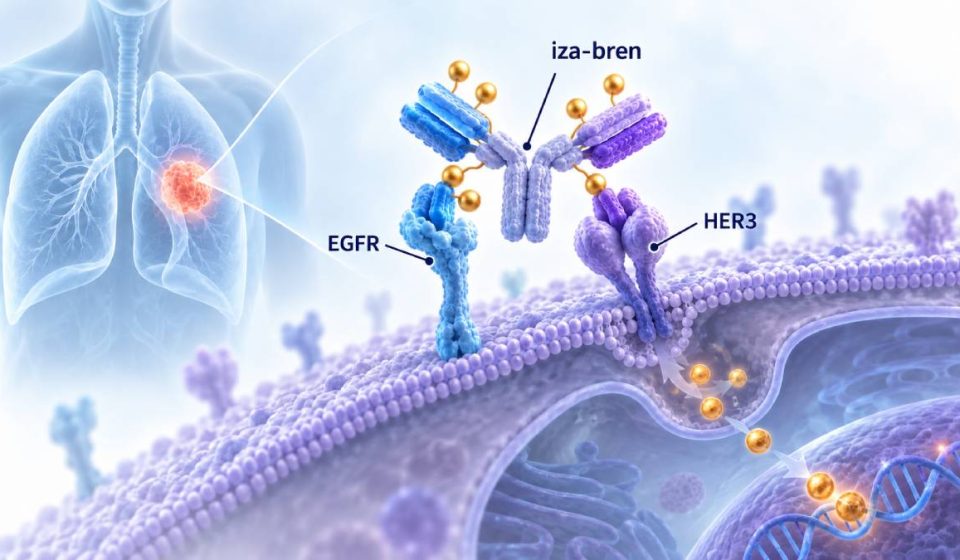
Iza-bren, also known as BL-B01D1, combines an EGFR×HER3 bispecific antibody with the topoisomerase I inhibitor payload Ed-04 through a cleavable tetrapeptide linker.
The design brings two approaches together: targeting receptor pathways involved in tumor growth and delivering a cytotoxic drug after cellular uptake. SystImmune describes the construct as blocking EGFR and HER3 signaling while releasing its payload following antibody-mediated internalization. The drug is being developed through a collaboration with Bristol Myers Squibb. SystImmune’s program overview
The clinical question is whether this approach can deliver a sufficiently durable benefit after resistance to EGFR inhibitors, with toxicity that patients can tolerate over repeated cycles.
The next test is against chemotherapy
The selected regimen will be evaluated in IZABRIGHT-Lung01, NCT07100080, a randomized, open-label Phase 2/3 study comparing iza-bren with platinum-based chemotherapy in EGFR-mutated NSCLC following progression on EGFR TKI therapy.
A trial listing from Dana-Farber Cancer Institute specifies a platinum-pemetrexed comparator and eligibility that includes progression on a third-generation EGFR TKI-based regimen.
That study will address the question the Phase 1 cohort cannot answer: whether iza-bren improves outcomes relative to an established treatment option. The current results support advancing the 2.5 mg/kg regimen, while leaving its eventual role in treatment sequencing dependent on the comparative efficacy and safety data.
References
- SystImmune. New global iza-bren data at WCLC 2026. September 12, 2026.
- Spira A, Chae Y, Gregorc V, et al. Phase 1 Global Study of Iza-bren in Patients With Metastatic EGFR-mutated NSCLC: Results of the Randomized Dose Expansion Cohort. Abstract OA10.01, WCLC 2026. February-cutoff figures reproduced from the abstract summary supplied for this article.
- ClinicalTrials.gov. Global Phase 1 study: NCT05983432.
- ClinicalTrials.gov. IZABRIGHT-Lung01: NCT07100080.
- Dana-Farber Cancer Institute. IZABRIGHT-Lung01 trial description and eligibility.