BioNTech and OncoC4’s Gotistobart Nearly Doubles Survival in Previously Treated Squamous NSCLC
Updated PRESERVE-003 data showed median overall survival of 18.5 months with the CTLA-4 antibody, compared with 10 months for docetaxel. The result is encouraging, but confirmation must come from the ongoing pivotal stage of the Phase 3 trial.
BioNTech and OncoC4 have reported an encouraging overall survival result for gotistobart in previously treated squamous non-small cell lung cancer, giving the partners their clearest evidence yet that the experimental CTLA-4 antibody may offer an effective chemotherapy-free option after immunotherapy resistance develops.
In the non-pivotal first stage of the Phase 3 PRESERVE-003 trial, gotistobart reduced the risk of death by 44% compared with docetaxel. Median overall survival reached 18.5 months with gotistobart versus 10.0 months with chemotherapy, according to updated data presented at the 2026 World Conference on Lung Cancer.
The hazard ratio was 0.56, with a nominal p-value of 0.0295. The findings were based on a July 17, 2026 data cutoff and a median follow-up of 25.4 months, BioNTech and OncoC4 announced.
The analysis included 87 patients with metastatic squamous NSCLC whose disease had progressed after treatment with a PD-1 or PD-L1 inhibitor and platinum-based chemotherapy. Forty-five patients received gotistobart, while 42 received docetaxel.
Gotistobart was administered at 6 mg/kg every three weeks following two loading doses of 10 mg/kg. Patients in the control arm received docetaxel at 75 mg/m² every three weeks.
A meaningful result in a difficult treatment setting
Patients with metastatic squamous NSCLC have relatively few effective options once their cancer progresses after chemoimmunotherapy. Unlike non-squamous lung cancer, where several molecularly targeted therapies are available for defined genomic subgroups, later-line treatment for squamous disease still relies heavily on cytotoxic chemotherapy.
Docetaxel remains a common comparator in this setting despite modest efficacy and considerable toxicity. Against that background, an 8.5-month difference in median overall survival is clinically striking.
The hazard ratio is equally relevant. A value of 0.56 indicates that gotistobart was associated with a 44% reduction in the risk of death during the analysis period compared with docetaxel.
The result should still be interpreted in the context of the trial’s design. This analysis came from the relatively small, non-pivotal first stage of PRESERVE-003, and the reported p-value was nominal. The data therefore provide a strong signal rather than the registrational confirmation needed to establish gotistobart as a new standard of care.
That confirmation is expected to come from the ongoing pivotal second stage, which is being conducted at more than 160 sites worldwide.
Safety broadly comparable with docetaxel
The updated analysis did not reveal a clear disadvantage for gotistobart in the headline safety comparison. Grade 3 or higher treatment-related adverse events occurred in 44.4% of patients receiving gotistobart and 48.8% of those receiving docetaxel.
BioNTech described the antibody’s safety profile as manageable and consistent with earlier findings. That comparison is important because conventional CTLA-4 inhibitors can produce serious immune-related toxicities, limiting how broadly and intensively they can be used.
A complete assessment will require the detailed adverse-event profile, including the incidence and severity of immune-mediated events, treatment discontinuations and any treatment-related deaths. Even so, the current figures support further evaluation of gotistobart’s differentiated design.
A different approach to CTLA-4
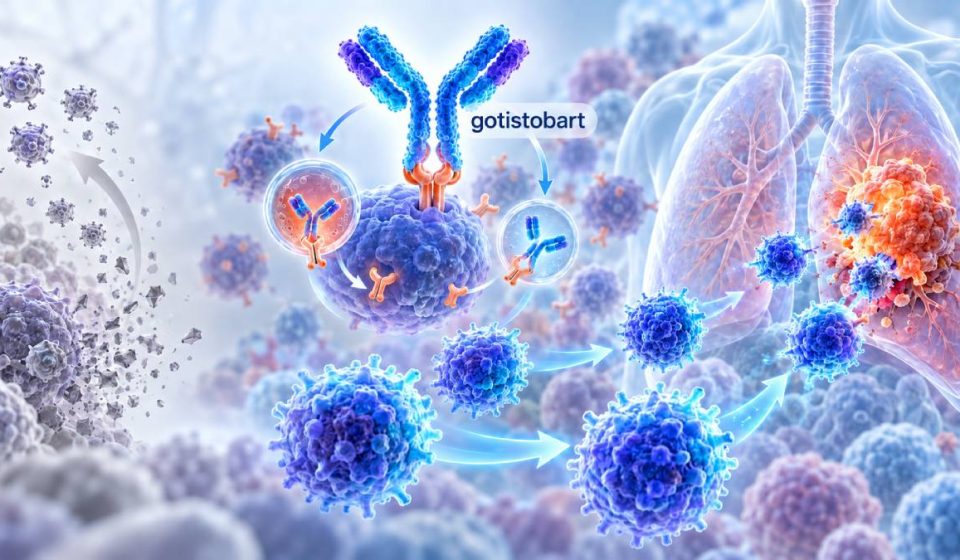
Gotistobart, also known as BNT316 or ONC-392, is a pH-sensitive monoclonal antibody targeting CTLA-4. It was designed to deplete regulatory T cells within the tumor microenvironment and restore antitumor immune activity while preserving CTLA-4 recycling.
After the antibody binds CTLA-4 on the cell surface, the complex is taken into the cell. The more acidic environment inside the endosome causes gotistobart to dissociate from CTLA-4, allowing the receptor to recycle to the cell surface rather than being sent for lysosomal degradation.
This target-preserving behavior is intended to maintain CTLA-4’s normal immune-regulatory role in peripheral tissues while supporting stronger regulatory T-cell depletion inside tumors. The National Cancer Institute’s drug dictionary describes the same pH-dependent dissociation and CTLA-4 recycling mechanism.
The concept is an attempt to retain the antitumor potency associated with CTLA-4 blockade while improving its therapeutic window. The PRESERVE-003 findings do not prove that the mechanism will deliver a better benefit-risk profile across different cancers, but the survival result in immunotherapy-experienced lung cancer gives the hypothesis meaningful clinical support.
Pivotal stage will determine the program’s path
PRESERVE-003 is a two-stage, randomized, open-label Phase 3 study comparing gotistobart monotherapy with docetaxel. Overall survival is the primary endpoint, with response rate, progression-free survival and safety among the secondary measures.
The first stage initially enrolled patients across NSCLC histologies and was intended to identify the population most likely to benefit. The ongoing pivotal stage is focused on squamous NSCLC, reflecting the signal observed in that subgroup.
The updated survival analysis builds on earlier Stage 1 results published in Nature Medicine, which had already shown durable antitumor activity and an emerging survival advantage for gotistobart over docetaxel. The longer follow-up now provides a mature median survival estimate for the experimental arm.
Gotistobart has received FDA Fast Track designation for metastatic NSCLC that has progressed after PD-1 or PD-L1 therapy, as well as FDA Orphan Drug designation for squamous NSCLC. China’s National Medical Products Administration has also granted the program Breakthrough Therapy designation.
For BioNTech, the candidate is an important component of a widening oncology pipeline that extends beyond mRNA-based therapies. For OncoC4, the result offers clinical validation of its target-preserving antibody platform and its strategy of engineering a more selective form of CTLA-4-directed immunotherapy.
The 18.5-month median survival result makes gotistobart one of the more closely watched later-line immunotherapy programs in squamous NSCLC. The pivotal stage must now show that the magnitude of benefit holds in a larger, registrational population. If it does, gotistobart could challenge chemotherapy in a setting where treatment choices have changed very little over the past decade.
References
- BioNTech. “BioNTech and OncoC4 Present Updated Data Showing Gotistobart Nearly Doubled Median Overall Survival versus Standard-of-Care Chemotherapy in Previously Treated Squamous Non-Small Cell Lung Cancer Patients.” September 14, 2026.
- ClinicalTrials.gov. PRESERVE-003: Gotistobart versus Docetaxel in Metastatic NSCLC—NCT05671510.
- Cho BC et al. “Gotistobart or docetaxel in metastatic squamous non-small-cell lung cancer: Stage 1 of the randomized Phase 3 PRESERVE-003 trial.” Nature Medicine, 2026.
- National Cancer Institute. “Definition of Gotistobart.”
- BioNTech and OncoC4. “BioNTech and OncoC4 Initiate Pivotal Phase 3 Trial of BNT316/ONC-392 in Metastatic NSCLC.” June 29, 2023.