Novartis Acquires Global Rights to Sironax Brain-Delivery Platform for $125 Million
The Swiss pharmaceutical group has exercised its option to acquire Sironax’s technology for transporting large therapeutic molecules across the blood-brain barrier.
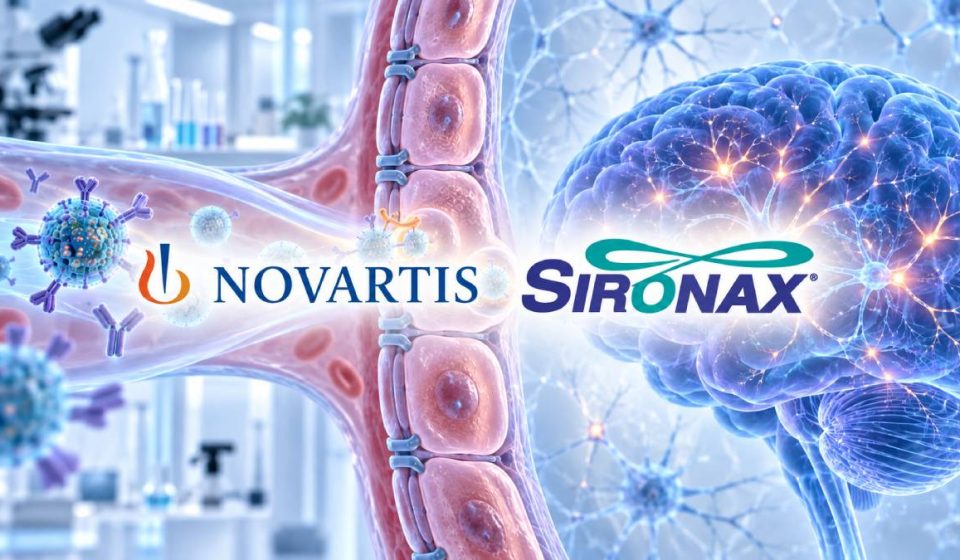
Novartis has exercised its exclusive option to acquire full global rights to Sironax’s proprietary brain-delivery platform, giving the pharmaceutical company control of a technology designed to address one of the most stubborn problems in neuroscience drug development.
Under the agreement, Sironax will receive $125 million when the transaction closes. The company will retain the right to develop, manufacture and commercialize selected assets that use the platform, according to its September 16 announcement.
The acquisition follows an option and asset-purchase agreement reached by the companies in July 2025. That arrangement gave Novartis an exclusive period in which to evaluate the technology before deciding whether to acquire it. By exercising the option, Novartis is moving from evaluating the platform to securing its global rights.
Tackling the blood-brain barrier
The scientific rationale behind the transaction is straightforward. The blood-brain barrier protects the central nervous system by tightly controlling which substances can enter the brain. That protective function also prevents many therapeutic molecules—particularly antibodies and other large biologics—from reaching their intended targets at effective concentrations.
Sironax has developed proprietary delivery modules intended to transport several types of therapies across this barrier in vivo. The platform could potentially be applied to monoclonal antibodies, peptides, proteins, gene therapies and other large biological medicines.
If the technology performs as intended, it could broaden the range of drug candidates available for neurological diseases such as Alzheimer’s disease, Parkinson’s disease, Huntington’s disease and amyotrophic lateral sclerosis. These are potential applications identified by Sironax, rather than established clinical outcomes.
The transaction gives Novartis another tool for developing medicines against targets that have historically been difficult to reach. It also reflects a broader pharmaceutical industry push to improve brain delivery as companies build pipelines around neurodegeneration and other central nervous system disorders.
Novartis has pursued additional technologies in this area. In 2025, the company entered an option agreement with BioArctic involving its BrainTransporter platform and secured rights to an amyloid-beta antibody program developed by SciNeuro Pharmaceuticals. The Sironax acquisition adds another approach to that growing brain-delivery portfolio, as reported by BioSpace and Fierce Biotech.
Sironax retains selected development rights
Although Novartis is acquiring global rights to the platform, Sironax is preserving the ability to use it with selected assets. The retained development, manufacturing and commercialization rights allow the biotech to continue participating in programs built around its technology while transferring the broader platform to a global drugmaker with considerably greater development resources.
For Sironax, the deal also provides substantial nondilutive capital at an important stage in its development. The company plans to use the proceeds to advance three Phase 1b/2 programs and several earlier-stage candidates.
Its clinical pipeline includes:
- SIR2501, an allosteric SARM1 inhibitor being developed to prevent neuroaxonal damage in conditions including amyotrophic lateral sclerosis and chemotherapy-induced peripheral neuropathy. The latter program has received Fast Track designation from the U.S. Food and Drug Administration.
- SIR4156, an allosteric NAMPT activator under development for metabolic dysfunction.
- SIR9900, a selective, brain-penetrant allosteric RIPK1 inhibitor being studied as a potential treatment for inflammatory and immunologic diseases.
The three programs address different biological pathways, but they fit Sironax’s broader research strategy of targeting degeneration, metabolic dysfunction and inflammation—processes the company views as important drivers of age-related disease.
A strategic validation for Sironax
The option exercise is an important endorsement of Sironax’s research. Novartis had the opportunity to assess the platform under the original agreement and has now decided to acquire it, suggesting that the technology cleared the scientific and strategic review needed to justify a larger commitment.
“The acquisition of our brain delivery platform by a global pharmaceutical leader marks a major milestone for Sironax and strongly validates our science, proprietary technology, and the expertise of our multidisciplinary R&D team,” Sironax President and CEO Shefali Agarwal said in the company’s announcement.
The deal also gives Sironax a favorable balance between near-term financing and longer-term participation. The company receives $125 million at closing to support its pipeline while retaining selected programs that could preserve future value from the platform.
For Novartis, the acquisition is a calculated investment in enabling technology rather than a bet on a single medicine. A delivery system that works across several therapeutic formats could support multiple neuroscience programs, giving the company more ways to pursue targets that conventional biologics cannot readily reach.
The transaction’s ultimate value will depend on how consistently the platform delivers therapeutically meaningful quantities of drugs into the brain and whether those programs produce convincing clinical results. Still, Novartis’s decision to exercise the option represents a meaningful vote of confidence in Sironax’s approach—and puts another promising blood-brain barrier technology in the hands of a company capable of testing it across a broad neuroscience portfolio.
References
- Sironax. “Sironax Announces Option Exercise and Asset Purchase.” September 16, 2026.
- Fierce Biotech. “Novartis Pays Sironax $125M to Acquire Platform for Crossing the Blood-Brain Barrier.” September 16, 2026.
- BioPharma Dive. “Novartis to Pay $125M for Blood-Brain Barrier Crossing Platform.” September 16, 2026.
- BioSpace. “Novartis Drops $125M for Sironax’s Tech to Cross Blood-Brain Barrier.” September 17, 2026.