RemeGen and AbbVie’s RC148 Delivers 90% Response Rate in a Phase 1b Trial of First-Line Squamous NSCLC
The PD-1/VEGF bispecific antibody produced high response rates with chemotherapy across squamous and non-squamous lung cancer cohorts, supporting its advancement into Phase 3 development.
RemeGen and AbbVie have reported strong early clinical results for RC148, also known as ABBV-1480, positioning the PD-1/VEGF bispecific antibody as another serious contender in one of oncology’s most competitive emerging drug classes.
In the Phase 1b RC148-C002 study, RC148 combined with platinum-based chemotherapy produced an objective response rate of 90.0% at the selected 10 mg/kg dose among previously untreated patients with locally advanced or metastatic squamous non-small cell lung cancer.
The combination also showed substantial activity in non-squamous disease, where the same dose produced an objective response rate of 75.9%. The findings were delivered in an oral presentation at the 2026 World Conference on Lung Cancer in Seoul.
AbbVie identified 10 mg/kg as the recommended Phase 3 dose for combination treatment in both NSCLC histologies. The company is already preparing a broader global development program, while RemeGen has advanced a China-based Phase 3 study in first-line squamous disease.
Response rates remain high in PD-L1-negative disease
The RC148-C002 analysis included 121 patients: 61 with squamous NSCLC and 60 with non-squamous disease. Patients were evaluated at RC148 doses of 10 mg/kg and 20 mg/kg, each administered with histology-appropriate chemotherapy.
In the squamous cohort, RC148 was combined with carboplatin and paclitaxel. Among 30 evaluable patients treated with the 10 mg/kg dose, 27 responded, producing an ORR of 90.0% with a 95% confidence interval of 73.5% to 97.9%.
Activity did not appear limited to tumors with established sensitivity to checkpoint inhibition. Among patients with PD-L1-negative squamous tumors, the reported ORR was 93.3%. Median progression-free survival in the 10 mg/kg group reached 10.8 months at the March 22, 2026 data cutoff.
For patients with non-squamous NSCLC, RC148 was combined with carboplatin and pemetrexed. The 10 mg/kg regimen produced an ORR of 75.9%, including a 71.4% response rate among patients whose tumors were PD-L1 negative.
Those PD-L1-negative results are particularly relevant. Checkpoint inhibitors generally work best in tumors with higher PD-L1 expression, while patients with PD-L1-negative disease tend to derive less benefit. A bispecific antibody that maintains substantial activity across PD-L1 categories could serve a broader first-line population, although the finding will need confirmation in randomized studies.
A dual attack on immune suppression and angiogenesis
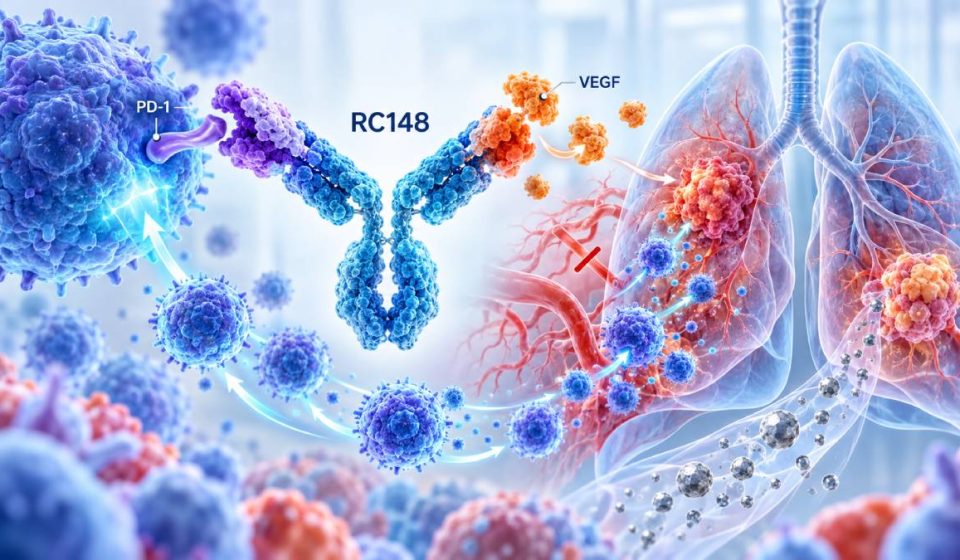
RC148 is designed to block two pathways that tumors use to survive. Its PD-1-targeting arm releases a brake on cancer-fighting T cells, while its VEGF-targeting component inhibits a central driver of tumor angiogenesis.
VEGF does more than stimulate the development of blood vessels. It also contributes to an immunosuppressive tumor microenvironment by impairing immune-cell trafficking and function. Blocking PD-1 and VEGF within a single molecule could therefore combine immune reactivation with local vascular and microenvironmental effects.
RemeGen describes RC148 as an antibody capable of activating an antitumor immune response while suppressing tumor-driven angiogenesis. AbbVie sees the approach as a potential foundation for multiple combinations, including regimens with its antibody-drug conjugates. The companies outlined that strategy when they announced their licensing agreement in January 2026.
Under the agreement, AbbVie received exclusive rights to develop, manufacture and commercialize RC148 outside Greater China. RemeGen received $650 million upfront and is eligible for as much as $4.95 billion in development, regulatory and commercial milestones, plus tiered double-digit royalties on sales outside Greater China.
Encouraging efficacy, but cross-trial comparisons require caution
The 90% response rate in squamous NSCLC is numerically higher than results reported for some competing PD-1/VEGF programs. That includes ivonescimab, also known as AK112, which produced a 71.2% response rate in its HARMONi-6 study.
The difference should not be interpreted as evidence that RC148 is clinically superior. The studies involved different patient populations, sample sizes, follow-up periods, chemotherapy backbones and assessment procedures. Early single-arm response rates can also decline as more patients are enrolled and responses mature.
RC148-C002 included only 30 evaluable patients at the selected 10 mg/kg dose in each histology cohort. The confidence interval around the 90% response rate was consequently broad. Progression-free and overall survival will provide a more durable measure of benefit than tumor shrinkage alone.
The result nevertheless clears an important early hurdle. RC148 produced frequent responses across both major NSCLC histologies, including in PD-L1-negative tumors, and showed enough activity at 10 mg/kg to justify its selection for Phase 3 testing.
Hematologic toxicity reflects an intensive combination
The most common treatment-related adverse events were hematologic, including reductions in white blood cells, neutrophils and platelets, as well as anemia. These events are also commonly associated with the chemotherapy backbones used in the study.
Grade 3 or higher treatment-related adverse events occurred in 66.7% and 71.0% of patients receiving the 10 mg/kg and 20 mg/kg regimens, respectively, in the squamous cohort. In the non-squamous cohort, the corresponding rates were 70.0% and 76.7%.
Although those rates are substantial, the lower dose showed a modestly more favorable safety profile in both cohorts while maintaining strong activity. No Grade 3 or higher hemorrhagic events were reported with the 10 mg/kg combinations, according to AbbVie’s WCLC disclosure.
Bleeding is a closely watched risk for VEGF-targeted therapies, particularly in squamous lung cancer, where tumors may involve major blood vessels. The absence of severe hemorrhage at the selected dose is therefore reassuring, although a much larger safety database will be needed to define the risk reliably.
Phase 3 trial will test RC148 against an active standard
RemeGen also presented the design of RC148-C301, a randomized, double-blind Phase 3 study evaluating RC148 plus platinum-based chemotherapy as first-line treatment for advanced squamous NSCLC.
The control arm uses tislelizumab plus chemotherapy, giving RC148 a more demanding benchmark than chemotherapy alone. The study is designed to determine whether adding VEGF blockade within the bispecific molecule improves outcomes beyond those achieved with an established PD-1-based regimen.
That head-to-head design matters. High response rates in an early study can establish proof of concept, but the central question for RC148 is whether dual PD-1/VEGF targeting can extend progression-free or overall survival without adding unacceptable toxicity.
The WCLC results give RemeGen and AbbVie a persuasive rationale for taking that question into Phase 3. RC148 has produced deep early activity, including among PD-L1-negative patients, and the selected 10 mg/kg dose appears to offer the more favorable balance between efficacy and safety.
The randomized program will now determine whether those early advantages translate into a clinically meaningful improvement over current first-line immunotherapy.
References
- AbbVie. “AbbVie to Present New Data at WCLC 2026 Showcasing Innovation Across Lung Cancer Pipeline.” August 21, 2026.
- ClinicalTrials.gov. RC148-C002: A Phase 1b Study of RC148 as Monotherapy or in Combination—NCT06883630.
- ClinicalTrials.gov. RC148-C301: RC148 Plus Platinum-Based Chemotherapy in First-Line Squamous NSCLC—NCT07416474.
- AbbVie and RemeGen. “AbbVie and RemeGen Announce Exclusive Licensing Agreement to Develop a Novel Bispecific Antibody for Advanced Solid Tumors.” January 12, 2026.
- RemeGen. “RemeGen and AbbVie Sign Exclusive Licensing Agreement for RC148.” January 12, 2026.
- International Association for the Study of Lung Cancer. 2026 World Conference on Lung Cancer.