Roche and MediLink’s Tam-Peli Reduces Death Risk by 54% in Phase 3 Small-Cell Lung Cancer Trial
Roche and MediLink Therapeutics have reported a substantial survival benefit for tambotatug pelitecan, the experimental B7-H3-targeted antibody-drug conjugate known as Tam-Peli, in patients with relapsed small-cell lung cancer.
In the Chinese Phase 3 TAISHAN-302 trial, patients receiving Tam-Peli lived a median of 13.3 months, compared with 9.4 months for those treated with topotecan. The hazard ratio of 0.46 represented a 54% reduction in the risk of death, meeting the study’s primary endpoint.
The interim findings were presented as a late-breaking Presidential presentation at the 2026 World Conference on Lung Cancer in Seoul. Roche’s announcement also reported simultaneous publication in The New England Journal of Medicine.
For MediLink, the results mark Tam-Peli’s second positive Phase 3 readout in China, following TAISHAN-301 in nasopharyngeal carcinoma. For Roche, they strengthen the case for moving the China-developed ADC into global Phase 3 trials.
Survival and tumor responses favor Tam-Peli
TAISHAN-302 enrolled 451 patients across 85 sites in China. Participants had progressed after one line of platinum-based chemotherapy, with or without a PD-L1 inhibitor, and were randomly assigned to Tam-Peli or topotecan in an open-label design.
The survival result was accompanied by improvements in progression-free survival and confirmed tumor responses:
| Endpoint | Tam-Peli, n=225 | Topotecan, n=226 | Treatment comparison |
|---|---|---|---|
| Median overall survival | 13.3 months | 9.4 months | HR 0.46; 95% CI 0.35–0.62; p<0.0001 |
| Median progression-free survival | 7.4 months | 2.8 months | HR 0.29; p<0.0001 |
| Confirmed objective response rate | 59.1% | 9.7% | p<0.0001 |
Source: Roche’s TAISHAN-302 results release.
The difference between the median survival estimates was 3.9 months. Nearly six in ten patients receiving Tam-Peli had a confirmed objective response, compared with fewer than one in ten receiving topotecan.
Taken together, the endpoints make a persuasive clinical case: better tumor control was accompanied by longer survival. Investigators also reported consistent benefits across prespecified subgroups defined by age, chemotherapy-free interval and the presence of liver or brain metastases. These subgroup findings support the overall result, although individual subgroups should not be interpreted as independently definitive trials.
An encouraging signal in patients with brain metastases
Among patients with brain metastases at baseline, median intracranial progression-free survival was 6.1 months with Tam-Peli versus 4.2 months with topotecan, with a hazard ratio of 0.43. Intracranial response rates were 32.4% and 2.9%, respectively.
These findings add an important dimension to the efficacy profile. They suggest activity against disease within the brain, but do not establish that Tam-Peli can replace radiotherapy or other local treatment approaches. The subgroup also requires careful interpretation alongside its size, eligibility criteria and prior brain-directed treatment.
Fewer severe treatment-related events, with pulmonary toxicity still relevant
Tam-Peli had a lower incidence of severe and serious treatment-related adverse events than topotecan:
| Safety measure | Tam-Peli | Topotecan |
|---|---|---|
| Grade ≥3 treatment-related adverse events | 46.4% | 74.7% |
| Serious treatment-related adverse events | 25.9% | 36.4% |
| Any-grade treatment-emergent ILD/pneumonitis | 4.9% | 1.4% |
| Grade 3 ILD/pneumonitis | 0.9% | 0.9% |
No grade 4 or grade 5 interstitial lung disease or pneumonitis events were reported. Roche’s safety summary
The lower overall rate of severe treatment-related toxicity strengthens Tam-Peli’s benefit-risk profile against topotecan. Nevertheless, the higher incidence of any-grade ILD or pneumonitis warrants attention. The absence of fatal pulmonary events in this analysis should not be confused with the absence of pulmonary risk.
A linker designed for two routes of payload release
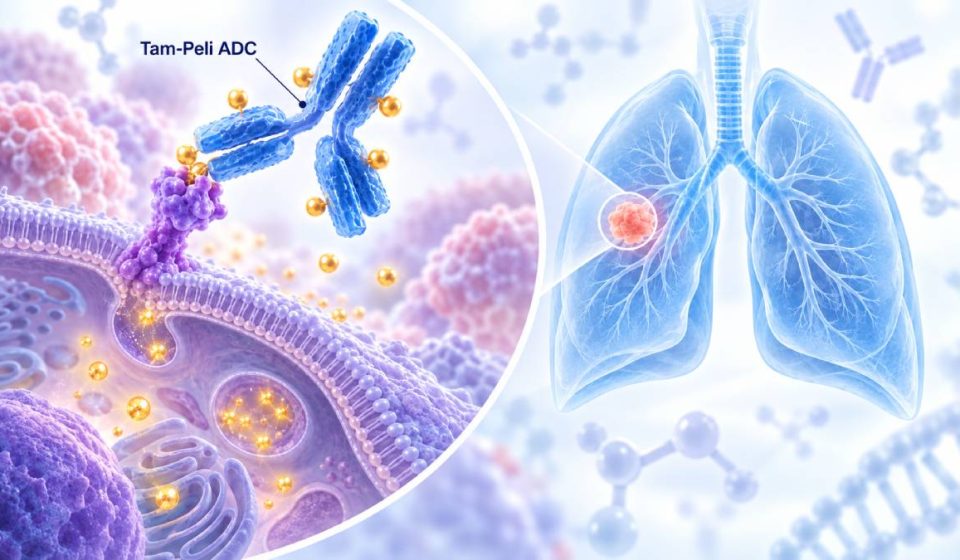
Tam-Peli, also known as YL201, uses MediLink’s TMALIN platform, short for Tumor Microenvironment-Activatable Linker. Its design combines a B7-H3-targeting antibody with a cytotoxic payload and a linker intended to remain stable during circulation.
The dual-release approach is designed to make the payload available both within tumor cells and in the surrounding tumor microenvironment. The aim is to improve drug delivery where it is needed while limiting exposure elsewhere.
That is the platform’s design rationale, rather than a mechanism proven by TAISHAN-302. The trial establishes the clinical performance of the complete ADC against topotecan; it cannot isolate how much of the benefit comes from the linker, antibody or payload individually.
China filing moves forward as Roche prepares global studies
Roche reported that China’s National Medical Products Administration had accepted the new drug application for filing. Acceptance starts the regulatory review process; it does not constitute marketing approval.
Roche holds development, manufacturing and commercialization rights to Tam-Peli worldwide outside mainland China, Hong Kong and Macau, and plans to rapidly initiate global Phase 3 trials. Roche’s development update
Those studies will be important in determining how the Chinese findings translate to broader patient populations and treatment settings. Longer follow-up will also help define the durability of benefit and the safety profile with extended exposure.
TAISHAN-302 gives the program a strong foundation: a randomized survival advantage, substantially higher response rates and fewer severe treatment-related adverse events than its chemotherapy comparator. The next task is to establish whether that profile can be reproduced globally and where Tam-Peli should fit into treatment for relapsed small-cell lung cancer.
References
- Roche. Roche’s collaborator MediLink announces Phase III data for Tam-Peli showing significantly improved overall survival in Chinese patients with relapsed small-cell lung cancer. September 13, 2026.
- ClinicalTrials.gov. TAISHAN-302 — NCT06612151.
- Zhang L, Zhao Y, Liu H, et al. Tam-Peli, an Anti-B7-H3 Antibody-Drug Conjugate, Versus Topotecan in Relapsed SCLC: A Randomized, Open-Label, Phase 3 Study (TAISHAN-302). WCLC 2026, abstract PL02.03; presentation details cited in Roche’s release.
- MediLink Therapeutics. TMALIN technology platform.