GSK and Hansoh’s Ris-Rez Cuts Risk of Death by 54% in Phase 3 Small-Cell Lung Cancer Trial
GSK and Hansoh Pharma’s B7-H3-directed antibody-drug conjugate risvutatug rezetecan delivered a striking survival benefit in relapsed small-cell lung cancer, potentially setting a new benchmark for a disease in which treatment progress has historically been difficult to achieve.
In the Phase 3 ARTEMIS-008 trial, commonly known as Ris-Rez, reduced the risk of death by 54% compared with topotecan in patients whose small-cell lung cancer had progressed following first-line platinum-based therapy. The findings were presented during a Presidential Symposium at the 2026 IASLC World Conference on Lung Cancer in Seoul.
According to GSK’s announcement, ARTEMIS-008 is the first Phase 3 trial of a B7-H3-targeted ADC to demonstrate an overall-survival benefit in any tumor type—a meaningful validation not only for Ris-Rez, but also for B7-H3 as a therapeutic target.
A substantial survival advantage
ARTEMIS-008 enrolled 461 patients in China with small-cell lung cancer that had relapsed after first-line platinum-based chemotherapy. Participants were randomized 1:1 to receive intravenous Ris-Rez at 8 mg/kg every three weeks or topotecan on days 1 through 5 of each three-week cycle.
At the prespecified interim analysis, median overall survival reached 18.5 months with Ris-Rez, compared with 10.3 months for topotecan. That translated into a hazard ratio of 0.46, with a highly significant p-value below 0.0001.
The benefit extended across the study’s other efficacy measures:
| Endpoint | Ris-Rez | Topotecan |
|---|---|---|
| Median overall survival | 18.5 months | 10.3 months |
| Risk of death | HR 0.46 | Reference |
| Median progression-free survival | 7.2 months | 3.0 months |
| Risk of progression or death | HR 0.33 | Reference |
| Objective response rate | 58.3% | 12.6% |
| Disease control rate | 90.4% | 60.2% |
| Median duration of response | 6.9 months | 5.6 months |
The progression-free survival and tumor-response results were assessed by blinded independent central review. Overall-survival benefits were also reported across prespecified subgroups, including patients differentiated by chemotherapy-free interval, disease stage and the presence of brain metastases.
The magnitude of the improvement matters. Ris-Rez did not merely delay progression; it extended median survival by more than eight months over an established chemotherapy comparator. Nearly six in ten patients experienced an objective response, compared with approximately one in eight receiving topotecan.
Lower rate of severe treatment-related toxicity
The safety findings add another important dimension to the results. Grade 3 or higher treatment-related adverse events occurred in 60.9% of patients receiving Ris-Rez and 78.2% of those treated with topotecan.
Hematologic toxicities—including reductions in neutrophils, white blood cells, lymphocytes and platelets, as well as anemia—were the most common severe treatment-related events in both groups.
Interstitial lung disease, however, remains a risk requiring close attention. ILD events were reported in 11.7% of Ris-Rez recipients versus 1.9% of patients receiving topotecan. Grade 3 or higher ILD occurred in 3.9% and 0.9%, respectively, although no grade 4 or fatal ILD cases were reported. Treatment-related deaths occurred in 1.3% of the Ris-Rez group and 0.9% of the topotecan group.
The overall profile therefore looks differentiated rather than toxicity-free: Ris-Rez produced fewer severe treatment-related adverse events and fewer dose reductions than topotecan, but pulmonary toxicity will require careful monitoring in future studies and, if approved, in clinical practice.
Why B7-H3 matters in small-cell lung cancer
Small-cell lung cancer or SCLC is aggressive, prone to early metastasis and frequently becomes resistant after an initial response to platinum-based treatment. Outcomes following relapse remain poor, especially when the disease returns quickly after first-line therapy.
B7-H3 is highly expressed across SCLC and several other solid tumors, while its expression in most normal tissues is comparatively limited. That profile has made it an attractive target for ADCs designed to carry potent cytotoxic drugs directly into cancer cells.
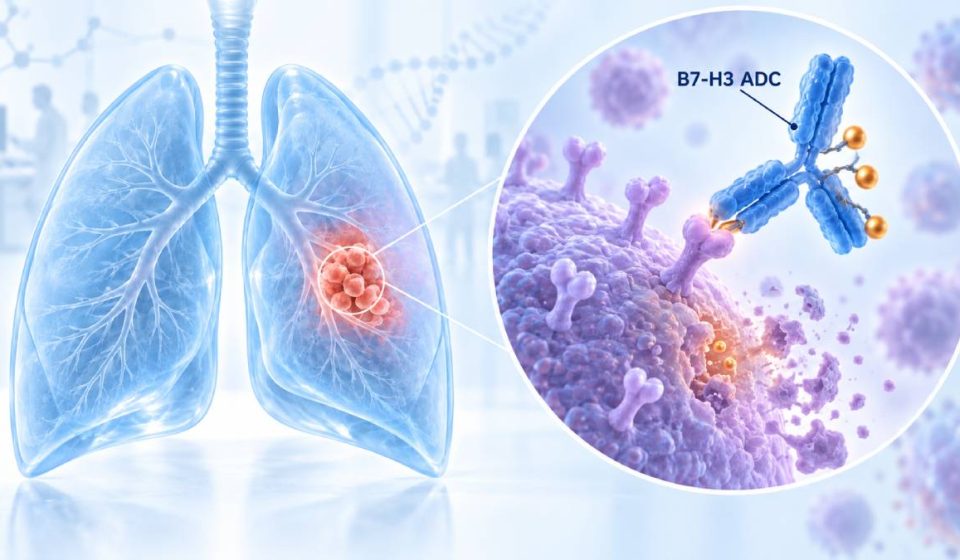
Ris-Rez combines a fully human anti-B7-H3 IgG1 antibody with rezetecan, a topoisomerase I inhibitor payload, through a cleavable linker. Once the ADC binds to B7-H3-expressing tumor cells and is internalized, the linker releases the payload, disrupting DNA replication and driving tumor-cell death.
The ARTEMIS-008 results provide the strongest evidence so far that this mechanism can translate into a meaningful survival advantage in a randomized Phase 3 setting.
From a China-developed asset to a global program
Ris-Rez originated at Hansoh Pharma, where it was previously known as HS-20093. In December 2023, GSK licensed exclusive rights to develop, manufacture and commercialize the drug outside mainland China, Hong Kong, Macau and Taiwan.
GSK paid Hansoh $185 million upfront, with the agreement providing for as much as $1.525 billion in additional development, regulatory and commercial milestones, plus tiered royalties on sales outside Greater China.
The company is now testing whether the strong Chinese results can be reproduced internationally. Its global Phase 3 EMBOLD-SCLC-301 trial is evaluating Ris-Rez against investigator’s-choice chemotherapy in patients with relapsed extensive-stage small-cell lung cancer.
GSK and Hansoh are also pursuing the ADC across a broader range of B7-H3-expressing malignancies. These include other lung-cancer settings, osteosarcoma and genitourinary tumors. Hansoh has already reported clinical activity from the Phase 2 ARTEMIS-003 program in metastatic castration-resistant prostate cancer.
Ris-Rez has received multiple regulatory designations, including FDA breakthrough-therapy designations in relapsed or refractory extensive-stage small-cell lung cancer and osteosarcoma. It has also secured orphan-drug designations covering small-cell lung cancer or related pulmonary neuroendocrine malignancies in the United States, Europe and Japan.
A potential change in the relapsed-SCLC landscape
ARTEMIS-008 was conducted entirely in China, so regulators and clinicians will still want to see confirmation from the global program. The analysis was also conducted at a prespecified interim point, meaning longer follow-up will further define durability, late toxicity and the shape of the survival curve.
Even with those qualifications, the data are difficult to dismiss. An 18.5-month median overall survival, accompanied by a 58.3% response rate and a lower incidence of severe treatment-related toxicity than topotecan, represents a compelling late-stage profile in relapsed small-cell lung cancer.
If the global trial confirms these findings, Ris-Rez could become an important treatment option for relapsed disease and establish B7-H3-directed ADCs as a major new therapeutic class in small-cell lung cancer. For GSK, it would also validate a central piece of the company’s expanding solid-tumor strategy; for Hansoh, it would mark another China-originated oncology program capable of competing on the global stage.
References
- GSK. Ris-Rez reduced risk of death by 54% versus topotecan in patients with relapsed small-cell lung cancer in China. September 2026.
- ClinicalTrials.gov. ARTEMIS-008: HS-20093 compared with topotecan in relapsed small-cell lung cancer.
- GSK. GSK enters exclusive license agreement with Hansoh for HS-20093. December 20, 2023.
- ClinicalTrials.gov. EMBOLD-SCLC-301 global Phase 3 study of risvutatug rezetecan.
- Hansoh Pharma. Phase 2 data for risvutatug rezetecan in metastatic castration-resistant prostate cancer. February 2026.