Chia Tai Tianqing Pharma (CTTQ)
Chia Tai Tianqing Pharmaceutical Group Co., Ltd. (CTTQ; 正大天晴药业集团股份有限公司) is one of China’s largest innovative pharmaceutical companies and the core operating enterprise of Hong Kong-listed Sino Biopharmaceutical Limited (SBP Group) (HKEX: 1177).
With roots dating to 1969, CTTQ has evolved from a traditional Chinese pharmaceutical manufacturer into a large R&D-driven biopharma with particular strength in oncology, liver disease and respiratory medicine. More recently, it has built increasingly sophisticated platforms around ADCs, multispecific antibodies, immuno-oncology, siRNA, PROTACs and AI-assisted small-molecule discovery.
The company is also becoming a significant source of China-originated assets for multinational pharmaceutical companies. Two major 2026 transactions—ro vadicitinib with Sanofi for up to US$1.53 billion and TQC3721 with AstraZeneca for up to US$1.9 billion—illustrate this transition. (en.sbpgroup.com)
This profile is updated through August 30, 2026.
CTTQ at a Glance
| Item | Details |
|---|---|
| English name | Chia Tai Tianqing Pharmaceutical Group Co., Ltd. |
| Chinese name | 正大天晴药业集团股份有限公司 |
| Abbreviation | CTTQ |
| Origin | 1969, Dongfeng Pharmaceutical Factory |
| CTTQ JV formation | 1997, joint venture with Thailand’s Chia Tai Group |
| Major locations | Lianyungang & Nanjing, Jiangsu; Shanghai |
| New global R&D HQ | Shanghai Hongqiao Qianwan |
| Business status | Private/unlisted subsidiary of a public company |
| Parent | Sino Biopharmaceutical / SBP Group |
| Parent ticker | HKEX: 1177 |
| Employees | 14,000+ |
| R&D employees | 1,800+ |
| 2025 R&D intensity | ~20% of sales |
| Pipeline | 130+ projects |
| Innovative drugs | 100+ projects |
| Core areas | Oncology, liver disease, respiratory disease |
| Additional areas | Autoimmune/inflammation, cardiovascular/metabolic, pain, infection |
| Technology platforms | Small molecules, antibodies/multispecifics, ADCs, siRNA, PROTACs, innovative formulations |
| International presence | 10+ products approved in 60+ countries/regions |
(cttq.com)
History and Corporate Structure
CTTQ traces its history to the establishment of Dongfeng Pharmaceutical Factory in 1969. In 1997, the business formed a joint venture with Thailand’s Chia Tai Group, laying the foundation for the modern Chia Tai Tianqing organization. (cttq.com)
An important distinction is that CTTQ itself is not separately publicly traded.
Instead, it is the core operating subsidiary of Sino Biopharmaceutical Limited, whose shares trade in Hong Kong under 1177.HK. Therefore, investors seeking public-market exposure to CTTQ generally obtain it through Sino Biopharmaceutical.
CTTQ historically established its leadership in China’s hepatology market, before building major oncology, respiratory and other franchises.
The company now operates five major R&D/manufacturing bases across Nanjing, Lianyungang and Shanghai. (cttq.com)
New Shanghai Global R&D Headquarters
One of CTTQ’s most important infrastructure developments occurred in 2026.
In June, the company formally opened its new global R&D headquarters in Shanghai’s Hongqiao Qianwan area.
The facility represents an investment of approximately:
RMB 1.8 billion
~US$266 million
and covers approximately 186,000 square meters.
The campus includes a comprehensive R&D building, two core laboratory buildings and supporting facilities. It is intended to support drug discovery through process development and ultimately commercial manufacturing. (en.shhqcbd.gov.cn)
This investment underscores CTTQ’s transition from a primarily domestic pharmaceutical manufacturer into a global innovation organization.
Therapeutic Areas
CTTQ historically manufactured products across numerous disease areas, but its innovation strategy is becoming increasingly concentrated.
1. Oncology
Oncology is now CTTQ’s largest innovative R&D area.
Its pipeline spans:
- breast cancer
- lung cancer
- liver cancer
- gastric cancer
- colorectal cancer
- hematologic malignancies
- ovarian/endometrial cancers
- prostate cancer
- pancreatic cancer
- other solid tumors
CTTQ says it has 57 Category 1 innovative oncology programs, including roughly 30 programs undergoing clinical trials and five that had reached filing stages. (cttq.com)
Major technology areas include:
ADCs • bispecific/trispecific antibodies • T-cell engagers • immune checkpoint therapies • targeted small molecules • PROTACs
2. Liver Disease
Hepatology remains one of CTTQ’s defining franchises.
The company has longstanding commercial strength in chronic hepatitis B and other liver diseases through products such as Tianqing Ganmei (magnesium isoglycyrrhizinate) and Runzhong.
Its next-generation hepatology pipeline targets:
- chronic hepatitis B functional cure
- MASH
- liver fibrosis/cirrhosis
- acute liver injury
Major candidates include lanifibranor, TQ-A3334, TQA3605 and Kylo-0603. (www1.hkexnews.hk)
3. Respiratory Disease
Respiratory medicine is rapidly becoming another major growth franchise.
CTTQ is developing therapies for:
- COPD
- asthma
- other inflammatory respiratory disorders
The centerpiece is currently TQC3721, an inhaled PDE3/4 inhibitor now in Phase III development for COPD and licensed outside China to AstraZeneca. (astrazeneca.com.cn)
4. Autoimmune/Inflammatory Disease
CTTQ/SBP is also expanding aggressively into immunology through programs including ro vadicitinib, a dual JAK/ROCK inhibitor.
Additional programs explore novel immune-modulating targets and multispecific antibodies.
Current Innovative Drug Pipeline
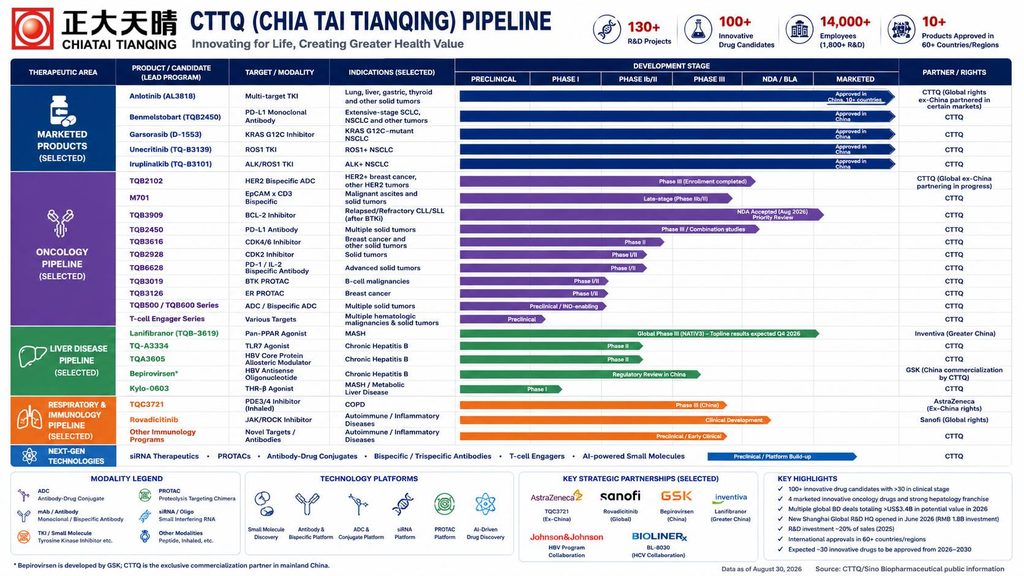
CTTQ reports more than 130 R&D programs, including over 100 innovative drugs as of year-end 2025. (cttq.com)
A representative selection of the most strategically important programs follows.
| Candidate | Target / modality | Major indication | Approx. status |
|---|---|---|---|
| Anlotinib | Multi-target TKI | Multiple solid tumors | Marketed / lifecycle expansion |
| Benmelstobart | PD-L1 mAb | SCLC and other tumors | Marketed / Phase III expansion |
| Garsorasib | KRAS G12C inhibitor | NSCLC/other tumors | Marketed / expansion |
| Unecritinib | ROS1 TKI | ROS1+ NSCLC | Marketed |
| Iruplinalkib | ALK/ROS1 TKI | ALK+ NSCLC | Marketed |
| TQB2102 | HER2 bispecific ADC | Breast & other HER2 tumors | Phase III |
| M701 | EpCAM×CD3 bispecific | Malignant ascites/solid tumors | Late-stage |
| TQB3909 | BCL-2 inhibitor | CLL/SLL | NDA / Priority Review |
| TQB2450 | PD-L1 antibody | Multiple cancers | Phase III/combination development |
| TQB3616 | CDK4/6 inhibitor | Breast/other cancers | Clinical |
| TQB2928 | CDK2 inhibitor | Solid tumors | Clinical |
| TQB6628 | PD-1/IL-2 bispecific | Solid tumors | Clinical/early development |
| TQB3019 | BTK PROTAC | B-cell malignancies | Clinical |
| TQB3126 | ER PROTAC | Breast cancer | Clinical |
| TQC3721 | PDE3/4 inhibitor | COPD | Phase III |
| Lanifibranor | Pan-PPAR agonist | MASH | Global Phase III |
| TQ-A3334 | TLR7 agonist | Chronic hepatitis B | Phase II |
| TQA3605 | HBV core protein allosteric modulator | Chronic hepatitis B | Phase II |
| Kylo-0603 | THR-β agonist | MASH | Phase I |
| Rovadicitinib | JAK/ROCK inhibitor | Immunologic diseases | Clinical; licensed to Sanofi |
| TRD205 | AT2R antagonist | Pain | Phase II completed |
CTTQ’s parent expects approximately 30 innovative drugs to obtain approvals between 2026 and 2030, with more than ten programs potentially capable of exceeding RMB2 billion in peak domestic sales individually. (cttq.com)
TQB2102: Next-Generation HER2 Bispecific ADC
One of the most important internally developed CTTQ programs is TQB2102.
Unlike conventional HER2 ADCs, TQB2102 uses a bispecific/biparatopic HER2 antibody architecture, recognizing two HER2 epitopes.
It is now undergoing multiple pivotal trials in breast cancer.
HER2-positive breast cancer
In March 2026, CTTQ announced that its Phase III TQB2102-III-02 trial had completed enrollment in patients with advanced HER2-positive breast cancer. (cttq.com)
A separate registrational study in HER2-low breast cancer had already completed enrollment.
TQB2102 has also received Breakthrough Therapy recognition in China for neoadjuvant treatment of HER2-positive breast cancer.
Earlier Phase II neoadjuvant results reported a total pathological complete response rate of 73.1%, rising to 76.9% at 6 mg/kg. (cttq.com)
If the pivotal studies confirm these findings, TQB2102 could become one of CTTQ’s most important next-generation oncology products.
TQB3909: BCL-2 Inhibitor Approaches Market
Another major 2026 development came from TQB3909, CTTQ’s internally discovered BCL-2 inhibitor.
On August 4, 2026, CTTQ announced that China’s CDE had accepted the NDA for TQB3909 for adults with relapsed/refractory CLL/SLL previously treated with at least a BTK inhibitor-containing regimen.
The drug had already entered Priority Review on July 13. (cttq.com)
Earlier Ib/II results showed:
| Measure | Result |
|---|---|
| Efficacy-evaluable patients | 23 |
| ORR | 82.6% |
| CR/CRi | 26.1% |
| High/very-high-risk CLL-IPI ORR | 83.3% |
These early results and the NDA acceptance make TQB3909 one of CTTQ’s most immediate potential new commercial products.
Anlotinib: Established Oncology Franchise
Anlotinib (AL3818; FOCUS V) remains one of CTTQ’s most commercially important internally developed innovative drugs.
The oral multi-target tyrosine kinase inhibitor inhibits VEGFR, FGFR, PDGFR and other pathways and has accumulated approvals across multiple cancers.
It has become particularly important as the backbone for CTTQ’s combination oncology strategy, including combinations with benmelstobart, the company’s PD-L1 antibody.
Anlotinib is also undergoing international clinical development and has previously received FDA orphan-drug designations for selected cancers. (cttq.com)
Liver Disease Pipeline
CTTQ’s long-established hepatology franchise is moving from conventional antiviral therapy toward functional cure and metabolic liver disease.
Lanifibranor
Lanifibranor is a pan-PPAR agonist licensed from Inventiva for Greater China.
It is currently undergoing the global Phase III NATiV3 trial for MASH, with CTTQ participating in China. China’s NMPA previously granted the drug Breakthrough Therapy Designation. (sec.gov)
Topline NATiV3 results are targeted for Q4 2026, making this one of CTTQ’s most important near-term clinical catalysts.
Chronic hepatitis B
CTTQ is simultaneously pursuing novel HBV mechanisms:
| Candidate | Mechanism | Stage |
|---|---|---|
| TQ-A3334 | TLR7 agonist | Phase II |
| TQA3605 | HBV core-protein allosteric modulator | Phase II |
| Bepirovirsen* | HBV antisense oligonucleotide | Regulatory review |
| Kylo-0603 | THR-β agonist | Phase I / metabolic liver disease |
*GSK-developed; CTTQ is the Chinese commercialization partner for bepirovirsen rather than its originator. (gsk.com, www1.hkexnews.hk)
GSK Partnership: Bepirovirsen
One of CTTQ’s most strategically important recent commercial partnerships is with GSK.
In May 2026, GSK and Sino Biopharmaceutical, through CTTQ, entered an exclusive strategic collaboration to commercialize bepirovirsen in mainland China.
Bepirovirsen is an antisense oligonucleotide being developed as a potential functional-cure treatment for chronic hepatitis B and is under priority regulatory review in China. (gsk.com)
Under the arrangement:
CTTQ handles
- importation
- distribution
- hospital access
- promotional activities
GSK retains
- marketing authorization
- regulatory responsibilities
- quality and pharmacovigilance
- global medical strategy.
CTTQ brings access to more than 5,000 Chinese medical centers, providing GSK with a ready-made hepatology commercial infrastructure.
Interestingly, GSK also obtained the ability to review selected early-stage SBP pipeline assets for potential future collaborations outside China.
TQC3721: US$1.9 Billion AstraZeneca Deal
Perhaps CTTQ’s most important recent out-licensing transaction occurred in July 2026.
AstraZeneca acquired exclusive rights to TQC3721 outside China.
TQC3721 is an inhaled small-molecule PDE3/4 inhibitor currently undergoing a Phase III trial in China for COPD. (astrazeneca.com.cn)
Transaction economics
| Component | Value |
|---|---|
| Upfront payment | US$200M |
| Development/regulatory/sales milestones | Up to US$1.9B |
| Royalties | Tiered, up to double-digit % |
| AstraZeneca territory | Outside China |
| CTTQ/SBP territory | China |
AstraZeneca also obtained exclusive global rights to certain future development programs associated with TQC3721.
The deal is strategically significant because respiratory disease is one of AstraZeneca’s core global franchises and provides CTTQ with validation of its ability to originate internationally competitive non-oncology medicines.
Rovadicitinib: US$1.53 Billion Sanofi Deal
Only four months before the AstraZeneca agreement, CTTQ completed another major global out-license.
In March 2026, CTTQ granted Sanofi exclusive worldwide rights to ro vadicitinib, a first-in-class oral JAK/ROCK dual inhibitor. (en.sbpgroup.com)
Deal economics
| Component | Value |
|---|---|
| Upfront payment | US$135M |
| Total potential value | Up to US$1.53B |
| Royalties | Tiered, up to double-digit % |
| Rights | Global |
Combined, the Sanofi and AstraZeneca deals provide CTTQ/Sino Biopharmaceutical with approximately:
US$335 million in upfront payments
and more than:
US$3.4 billion in potential transaction value.
This represents an important validation of CTTQ’s transition from primarily importing/licensing global innovations into China toward exporting China-originated innovation globally.
Major Partnerships
CTTQ increasingly operates through both license-in and license-out transactions.
| Partner | Asset / area | Relationship |
|---|---|---|
| AstraZeneca | TQC3721 | Ex-China global license |
| Sanofi | Rovadicitinib | Global license |
| GSK | Bepirovirsen | China commercialization |
| Inventiva | Lanifibranor | Greater China license/development |
| Johnson & Johnson | HBV program | Research/licensing collaboration |
| BioLineRx | BL-8030 | HCV development collaboration |
CTTQ’s stated partnering interests include oncology, liver disease, respiratory disease, cardiovascular medicine and anti-infectives, encompassing licensing, co-development, technology transfer and manufacturing. (cttq.com)
Financing and Funding Status
CTTQ’s financing situation differs substantially from that of a typical independent Chinese biotech.
Because it is a major subsidiary of Sino Biopharmaceutical, CTTQ does not depend primarily on venture financing or periodic private funding rounds.
Instead, its development is financed through:
commercial pharmaceutical cash flow + parent-company resources + licensing income + partnership payments.
That model provides CTTQ with substantially more internal funding capacity than many clinical-stage Chinese biotechnology companies.
One indicator is R&D intensity: in 2025, CTTQ invested approximately 20% of sales into R&D. It employs more than 1,800 R&D personnel, over 60% of whom hold master’s degrees or higher. (cttq.com)
International BD is becoming another meaningful source of capital. At the broader Sino Biopharmaceutical level, out-licensing revenue reached RMB980 million in H1 2026. (cttq.com)
The group says four major multinational out-licensing transactions now represent:
>$1 billion in aggregate upfront payments
and
>$7 billion in aggregate potential deal value. (cttq.com)
Not all of these deals originated directly from CTTQ, so these figures should be viewed as SBP Group rather than standalone CTTQ financial metrics.
Technology Strategy
CTTQ’s evolution is increasingly visible in its technology mix.
Traditional CTTQ
Small-molecule drugs → generics → liver disease → oncology
Current CTTQ/SBP innovation engine
Small molecules
↓
Next-generation immuno-oncology
↓
Bispecific/trispecific antibodies
↓
ADCs / bispecific ADCs
↓
T-cell engagers
↓
PROTACs
↓
siRNA
↓
AI-designed medicines
The broader SBP organization is now developing next-generation assets such as TQB6628 (PD-1/IL-2 bispecific) and several novel ADC and siRNA programs. (cttq.com)
AI is also becoming increasingly important. Sino Biopharmaceutical says it invested approximately RMB600 million over the past three years in AI-enabled pharmaceutical R&D and operations, covering small molecules, ADCs, siRNA, molecular glues and other technologies. (cttq.com)
TQB3909—the BCL-2 inhibitor now under NDA review—is cited as one output of this AI-assisted small-molecule platform.
Latest Commercial and Clinical Developments
CTTQ enters the second half of 2026 with an unusually dense series of catalysts.
| 2026 development | Significance |
|---|---|
| TQB3909 NDA accepted + Priority Review | Potential new BCL-2 commercial franchise |
| TQB2102 Phase III enrollment completed | HER2 bispecific ADC approaching registrational readouts |
| TQC3721 Phase III COPD | Major respiratory asset; AstraZeneca ex-China license |
| Rovadicitinib → Sanofi | Global validation of CTTQ immunology innovation |
| Bepirovirsen → CTTQ/GSK | Potential expansion of CTTQ’s HBV leadership |
| Lanifibranor NATiV3 | Major Phase III MASH readout expected Q4 2026 |
| Shanghai R&D headquarters opened | RMB1.8B global innovation infrastructure |
| International BD acceleration | Increasing licensing income and global development |
What to Watch Next
The next 12–24 months could be particularly important for CTTQ.
TQB2102 is arguably the most important internally controlled oncology asset to watch. Positive Phase III results could establish CTTQ as a meaningful competitor in the increasingly crowded global HER2 ADC market.
TQB3909 is much closer to commercialization. Its August 2026 NDA acceptance and Priority Review create the possibility of another internally discovered targeted oncology drug reaching the Chinese market.
TQC3721 could become a major respiratory franchise. CTTQ retains China economics while AstraZeneca provides global clinical and commercial infrastructure elsewhere.
Lanifibranor’s Q4 2026 Phase III readout is another major catalyst. Positive NATiV3 data could give CTTQ an important position in China’s rapidly developing MASH market. (sec.gov)
Finally, the Sanofi and AstraZeneca transactions raise an important strategic question: which CTTQ asset will be licensed globally next?
The GSK agreement explicitly gives GSK an opportunity to review certain early-stage SBP assets, suggesting additional multinational transactions could follow. (gsk.com)
Overall Assessment
CTTQ occupies a somewhat unusual position within China’s biopharmaceutical industry.
It combines the scale and commercial infrastructure of a traditional pharmaceutical company with an increasingly biotech-like innovation engine. Unlike many Chinese biotech companies, it already possesses large-scale manufacturing, nationwide commercialization, substantial internal cash generation and a 14,000+ employee organization. (cttq.com)
At the same time, the composition of its pipeline is changing rapidly.
The first generation of CTTQ innovation produced drugs such as anlotinib. The current generation includes benmelstobart, garsorasib and multiple targeted medicines, while the next generation is increasingly centered on HER2 bispecific ADCs, T-cell engagers, next-generation immune modulators, PROTACs, siRNA and AI-designed drugs.
The US$1.53 billion Sanofi rovadicitinib deal and up-to-US$1.9 billion AstraZeneca TQC3721 transaction are particularly important milestones. They demonstrate that CTTQ is moving beyond being a company that primarily commercializes medicines in China toward becoming an originator of globally licensed innovative drugs. (en.sbpgroup.com)
With 130+ R&D programs, 100+ innovative drug candidates, roughly 20% of sales being reinvested into R&D, a new RMB1.8 billion Shanghai global R&D headquarters and the financial backing of Sino Biopharmaceutical, CTTQ has one of the broader innovation engines among China’s established pharmaceutical companies. (cttq.com)
Key sources
CTTQ — Official Company Profile
CTTQ — R&D Overview and Pipeline
CTTQ — Corporate Overview, updated through 2025
CTTQ/SBP — 2026 Interim Results and Pipeline Update
AstraZeneca — TQC3721 Licensing Agreement
SBP Group — Sanofi/Rovadicitinib Agreement
GSK — Bepirovirsen/CTTQ Collaboration
CTTQ — TQB3909 NDA and Priority Review
CTTQ — TQB2102 Phase III Update
Inventiva — Lanifibranor/CTTQ Development