Kelun-Biotech Biopharma
Sichuan Kelun-Biotech Biopharmaceutical Co., Ltd. (四川科伦博泰生物医药股份有限公司; HKEX: 6990) is one of China’s leading antibody-drug conjugate (ADC) developers and an increasingly important global oncology company. Founded in 2016 and headquartered in Chengdu, Sichuan, Kelun-Biotech has built a vertically integrated drug-development organization spanning discovery, clinical development, manufacturing and commercialization.
The company’s centerpiece is its proprietary OptiDC™ ADC and novel drug-conjugate platform, which has generated a broad pipeline led by the TROP2 ADC sacituzumab tirumotecan (sac-TMT; SKB264/MK-2870). Kelun-Biotech’s extensive licensing relationship with Merck & Co. (MSD) has also made it one of the most prominent examples of a Chinese biotech supplying internally discovered oncology assets to global pharmaceutical development.
As of August 2026, Kelun-Biotech reports 30+ innovative drug projects, more than 10 clinical-stage programs, four marketed products covering eight approved indications, and two projects covering three indications at the NDA stage. (prnewswire.com)
Company at a Glance
| Item | Details |
|---|---|
| Full name | Sichuan Kelun-Biotech Biopharmaceutical Co., Ltd. |
| Chinese name | 四川科伦博泰生物医药股份有限公司 |
| Founded | 2016 |
| Headquarters | Chengdu, Sichuan Province, China |
| Business status | Public company |
| Stock exchange | Hong Kong Stock Exchange |
| Ticker | 6990.HK |
| IPO | July 11, 2023 |
| Controlling shareholder | Sichuan Kelun Pharmaceutical Co., Ltd. (SZSE: 002422) |
| Core therapeutic area | Oncology |
| Expanding areas | Autoimmune/inflammation and metabolic diseases |
| Technology focus | ADCs, novel drug conjugates, bispecific antibodies, monoclonal antibodies, small molecules |
| Core platform | OptiDC™ |
| Pipeline | 30+ innovative programs |
| Clinical-stage pipeline | 10+ programs |
| Marketed products | 4 products / 8 approved indications |
| H1 2026 revenue | ~RMB978 million |
| H1 2026 product sales | ~RMB657 million, +112% YoY |
Kelun-Biotech is a holding subsidiary of Shenzhen-listed Kelun Pharmaceutical, rather than an entirely independent biotech. The company listed its H shares on the Hong Kong Stock Exchange on July 11, 2023. (hkex.com.hk, en.kelun-biotech.com)
History and Corporate Development
Kelun-Biotech was established in 2016 as the innovative-drug biotechnology arm of the broader Kelun pharmaceutical group.
Its origins, however, extend further back through Kelun’s biologics and ADC research activities. The company says it has accumulated more than a decade of experience developing ADCs and was among the first Chinese companies to establish an integrated ADC discovery and development platform. (en.kelun-biotech.com)
Important milestones include:
2019: FDA IND clearance for SKB264, enabling global Phase I/II development.
2021: Completion of Series A financing; licensing partnership with Ellipses Pharma for A400/EP0031.
2022: Major licensing agreements with MSD covering multiple ADC candidates.
2023: Completion of Series B financing and listing on the Hong Kong Stock Exchange.
2024: First commercial approval of sac-TMT.
2025: Commercial portfolio expanded substantially; Kelun-Biotech also raised approximately HK$1.94 billion through a share placement.
2026: HKEX approved removal of the company’s biotechnology “-B” marker, reflecting that Kelun-Biotech had satisfied the exchange’s requirements for operating as a commercial-stage issuer. The company subsequently completed another H-share placement in July 2026, raising approximately HK$2.72 billion net. (en.kelun-biotech.com)
Therapeutic Areas
Although Kelun-Biotech remains predominantly an oncology company, its pipeline is broadening.
Oncology
The company focuses particularly on high-incidence and difficult-to-treat tumors, including:
- breast cancer
- NSCLC
- gastric and colorectal cancer
- esophageal cancer
- ovarian and cervical cancers
- endometrial cancer
- urothelial cancer
- prostate cancer
- head and neck cancer
- nasopharyngeal carcinoma
Its oncology strategy increasingly centers on ADCs + immuno-oncology, including combinations of ADCs with PD-(L)1 inhibitors and PD-1/VEGF bispecific antibodies. (prnewswire.com)
Immunology and respiratory diseases
Kelun-Biotech has also expanded into:
- asthma
- atopic dermatitis
- COPD
- autoimmune diseases
Metabolic diseases
Metabolic disease is another strategic expansion area, although this portion of the pipeline remains considerably earlier than the company’s oncology franchise. (prnewswire.com)
Kelun-Biotech’s OptiDC™ Platform
The defining technology behind Kelun-Biotech is OptiDC™, its proprietary ADC and novel drug-conjugate platform.
Traditional ADCs essentially consist of three components:
Antibody → Linker → Cytotoxic payload
Kelun is expanding that concept considerably. Its newer conjugates can combine antibodies, peptides and small-molecule targeting components with cytotoxic, immune-stimulating, radioactive or protein-degrading payloads.
The company is developing both single- and dual-payload conjugates, including combinations such as:
cytotoxin + cytotoxin
cytotoxin + immune agonist
cytotoxin + degrader
This technology evolution is important because Kelun increasingly describes itself not simply as an ADC company but as a drug-conjugate (DC) platform company. (prnewswire.com)
Current Drug Pipeline
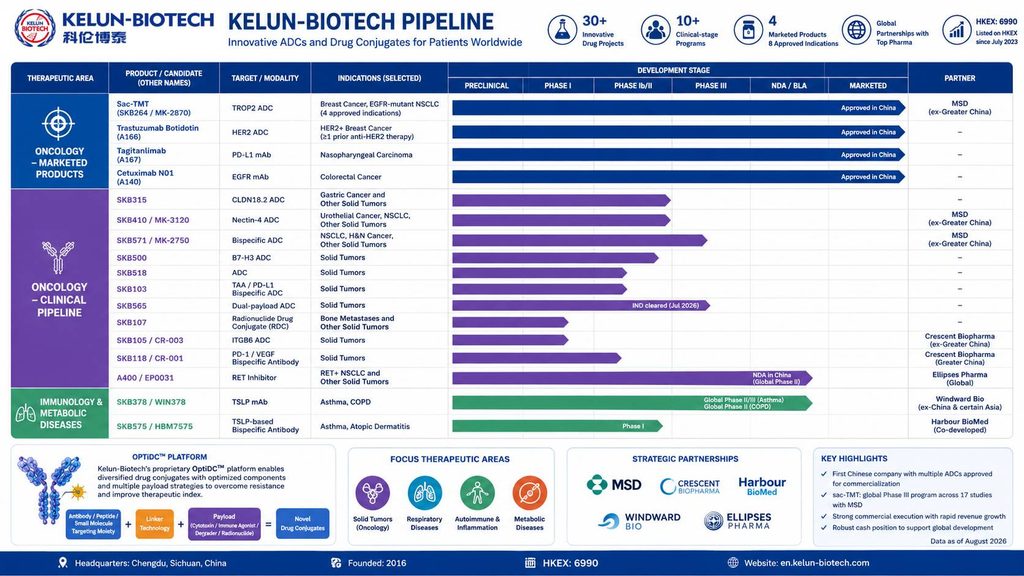
The following table summarizes the principal publicly disclosed programs as of August 2026.
| Candidate | Target / modality | Major indication(s) | Development status | Partner |
|---|---|---|---|---|
| Sac-TMT (SKB264/MK-2870) | TROP2 ADC | Breast, lung, EC, OC, UC & other tumors | Marketed + multiple global Phase III | MSD |
| A166 / trastuzumab botidotin | HER2 ADC | HER2+ breast cancer | Marketed | — |
| A167 / tagitanlimab | PD-L1 mAb | Nasopharyngeal carcinoma | Marketed | — |
| A140 / cetuximab N01 | EGFR mAb | Colorectal cancer | Marketed | — |
| A400 / EP0031 | RET inhibitor | RET+ NSCLC/solid tumors | NDA / global Phase II | Ellipses |
| SKB315 | CLDN18.2 ADC | Solid tumors | Clinical | |
| SKB410 / MK-3120 | Nectin-4 ADC | Solid tumors | Clinical | MSD |
| SKB571 / MK-2750 | Bispecific ADC | Solid tumors | Phase II | MSD |
| SKB500 | B7-H3 ADC | Solid tumors | Phase I/II | — |
| SKB518 | ADC | Solid tumors | Clinical | — |
| SKB107 | Radionuclide drug conjugate | Bone metastases | Clinical/preclinical development | — |
| SKB103 | TAA/PD-L1 bispecific ADC | Solid tumors | Clinical | — |
| SKB565 | Dual-payload ADC | Solid tumors | Phase I/II starting | — |
| SKB105 / CR-003 | ITGB6 ADC | Solid tumors | Phase I/II | Crescent |
| SKB118 / CR-001 | PD-1/VEGF bispecific | Solid tumors | Phase I/II | Crescent |
| SKB378 / WIN378 | TSLP mAb | Asthma, COPD | Global Phase II/III / Phase II | Harbour / Windward |
| SKB575 / HBM7575 | TSLP-based bispecific | Asthma, atopic dermatitis | Phase I | Harbour BioMed |
Kelun says its overall pipeline contains more than 30 programs, so the table focuses on the more visible clinical and strategically important candidates rather than every discovery-stage project. (prnewswire.com, en.kelun-biotech.com)
Sac-TMT: Kelun-Biotech’s Flagship Asset
The most important asset in Kelun-Biotech’s portfolio is sacituzumab tirumotecan, commonly called sac-TMT, and also known as SKB264/MK-2870.
It is a TROP2-directed ADC using a belotecan-derived topoisomerase-I inhibitor payload.
In Greater China, Kelun retains development and commercialization rights. MSD obtained exclusive rights outside Greater China in May 2022. (en.kelun-biotech.com)
Approved indications in China
As of August 2026, sac-TMT has obtained approval for four indications, covering:
| Setting | Status |
|---|---|
| 2L+ advanced TNBC | Approved |
| Later-line EGFR-mutant NSCLC | Approved |
| 2L EGFR-mutant NSCLC | Approved |
| 2L+ HR+/HER2− breast cancer | Approved — Feb. 2026 |
Two additional applications are under NMPA review:
First-line PD-L1-positive NSCLC — sac-TMT + pembrolizumab
First-line TNBC — sac-TMT monotherapy. (prnewswire.com)
Major 2026 Clinical Development: First-Line NSCLC
One of the most consequential developments for Kelun occurred in first-line NSCLC.
A Phase III trial evaluating:
sac-TMT + pembrolizumab
versus
pembrolizumab alone
in PD-L1-positive advanced NSCLC showed a statistically significant improvement in progression-free survival.
The reported PFS hazard ratio was 0.35, representing a 65% reduction in the risk of disease progression or death versus pembrolizumab monotherapy. An encouraging OS trend was also observed, with an HR of 0.55 at the reported analysis. Results were presented at ASCO 2026 and published in The Lancet. (prnewswire.com)
The NMPA has accepted the supplemental NDA and granted the combination Breakthrough Therapy Designation.
Separately, Kelun reported that its OptiTROP-Lung06 Phase III trial of sac-TMT plus pembrolizumab in first-line PD-L1-negative nonsquamous NSCLC met its primary endpoint. (prnewswire.com)
Together, these trials potentially position sac-TMT to move from later-line lung cancer treatment into the much larger first-line NSCLC market.
Global Development with MSD
The scale of MSD’s development program illustrates the strategic importance of sac-TMT.
As of August 2026, MSD had initiated 17 ongoing global Phase III studies evaluating sac-TMT either as monotherapy or in combinations across:
breast cancer • lung cancer • gynecologic cancers • gastrointestinal cancers • genitourinary cancers. (prnewswire.com)
One particularly important global readout arrived in May 2026.
TroFuse-005
The global Phase III TroFuse-005 trial evaluated sac-TMT in certain patients with advanced or recurrent endometrial cancer.
The trial met both primary endpoints:
Overall survival — positive
Progression-free survival — positive
Kelun says this represents the first global Phase III study in this setting to demonstrate statistically significant improvements in both OS and PFS versus chemotherapy, and the first ADC to achieve this result. (prnewswire.com)
Global Phase III programs in ovarian and urothelial cancers were also initiated during the first half of 2026.
A166 — Trastuzumab Botidotin
Kelun’s second marketed ADC is trastuzumab botidotin (A166; 舒泰莱®).
A166 targets HER2 and received NMPA approval in October 2025 for adults with HER2-positive breast cancer who had received at least one prior anti-HER2 therapy. (prnewswire.com)
The company continues to investigate A166 in patients previously treated with topoisomerase-I ADCs, an increasingly relevant question as HER2 ADC sequencing becomes more complex.
Other Commercial Products
Kelun-Biotech now has four marketed innovative products.
| Product | Target | Main approved indication(s) |
|---|---|---|
| 佳泰莱® / sac-TMT | TROP2 ADC | Breast cancer, EGFR-mutant NSCLC |
| 舒泰莱® / trastuzumab botidotin (A166) | HER2 ADC | HER2+ breast cancer |
| 科泰莱® / tagitanlimab (A167) | PD-L1 | Nasopharyngeal carcinoma |
| 达泰莱® / cetuximab N01 (A140) | EGFR | Colorectal cancer |
Three products covering five indications have entered China’s National Reimbursement Drug List (NRDL). (prnewswire.com)
Kelun’s commercial organization has grown rapidly to 800+ employees, covering 30 provinces, more than 300 prefecture-level markets and over 2,000 hospitals in China. (prnewswire.com)
A400 / Lunbotinib: RET Precision Medicine
Lunbotinib fumarate (A400/EP0031) is Kelun’s selective RET inhibitor being co-developed with Ellipses Pharma.
The program targets RET fusion-positive NSCLC and other RET-altered cancers.
Kelun has already submitted an NDA in China, and commercialization is expected in the first half of 2027 if approved. Meanwhile, FDA clearance allows Phase II development outside China, with 42 trial sites across the U.S., UK, continental Europe and UAE. (prnewswire.com)
Positive pivotal Phase II RET+ NSCLC data were presented at ASCO 2026.
Next Generation ADCs and Drug Conjugates
Kelun’s importance extends beyond sac-TMT. The company is attempting to create successive generations of conjugates using OptiDC.
SKB315 — CLDN18.2 ADC
SKB315 targets CLDN18.2, an increasingly important target in gastric and other gastrointestinal cancers.
SKB410 / MK-3120 — Nectin-4 ADC
SKB410 targets Nectin-4 and is part of the broader MSD/Kelun ADC collaboration.
SKB571 / MK-2750
SKB571 is a next-generation bispecific ADC partnered with MSD and is being studied in solid tumors including NSCLC and head-and-neck cancer.
SKB500 — B7-H3 ADC
SKB500 targets B7-H3, another high-interest ADC target. Kelun presented first-in-human data at ASCO 2026. (en.kelun-biotech.com)
SKB103 — bispecific ADC
SKB103 represents Kelun’s attempt to integrate tumor-associated-antigen targeting with PD-L1 biology within a bispecific ADC. Its IND was approved by the NMPA in March 2026. (en.kelun-biotech.com)
SKB565 — dual-payload ADC
SKB565 represents another evolution of the platform: rather than attaching a single payload class, it uses a dual-payload architecture.
The NMPA cleared SKB565 for clinical testing in July 2026. (en.kelun-biotech.com)
Expansion Beyond Oncology
A strategically important development is Kelun’s move into immunology and respiratory disease.
SKB378 / WIN378
SKB378 is a long-acting TSLP monoclonal antibody jointly originating from Kelun-Biotech and Harbour BioMed.
Global rights outside specified Asian territories were licensed to Windward Bio.
The program has advanced rapidly:
Asthma: POLARIS global Phase II/III trial
COPD: SIRIUS global Phase II trial, with first patients dosed in June 2026. (prnewswire.com)
SKB575 / HBM7575
SKB575 is a TSLP-based bispecific antibody developed with Harbour BioMed.
NMPA IND clearance has been obtained for atopic dermatitis and asthma, with Phase I trials underway. Under the partnership, Kelun leads design, global development and commercialization, while Harbour participates in investment and shares in the program’s economics. (prnewswire.com)
Major Partnerships
Kelun-Biotech has become notable for combining internal R&D with unusually large international licensing collaborations.
| Partner | Asset(s) | Relationship |
|---|---|---|
| MSD / Merck | sac-TMT + multiple ADCs | Global ex-Greater China development/licensing |
| Ellipses Pharma | A400/EP0031 | Global RET inhibitor development |
| Harbour BioMed | SKB378, SKB575 | Co-development |
| Windward Bio | SKB378/WIN378 | Ex-China/selected Asia global development |
| Crescent Biopharma | SKB105 + CR-001 | Reciprocal licensing + combination strategy |
The MSD Partnership
The relationship with Merck & Co. is arguably Kelun-Biotech’s most important strategic asset outside its technology itself.
The partnership began with individual ADC licensing agreements, including sac-TMT, before expanding dramatically.
In December 2022, MSD signed an agreement covering seven additional investigational ADC candidates. MSD also agreed to make an equity investment in Kelun-Biotech. (merck.com)
Combined with earlier transactions, the alliance gave MSD access to a broad collection of Kelun ADCs while providing Kelun with substantial upfront payments, potential development/regulatory/commercial milestones and royalties.
Most importantly, MSD has supplied the infrastructure needed to run very large multinational registrational programs.
The relationship has therefore evolved beyond a conventional asset license into something closer to a strategic ADC discovery and global-development alliance.
Crescent Biopharma Partnership
In December 2025, Kelun entered a reciprocal collaboration with Crescent Biopharma.
Kelun licensed SKB105/CR-003, its ITGB6-directed ADC, to Crescent outside Greater China.
Crescent simultaneously licensed its PD-1×VEGF bispecific antibody CR-001, now called SKB118, to Kelun for Greater China. (investors.crescentbiopharma.com)
Kelun received US$80 million upfront for SKB105 and is eligible for up to approximately US$1.25 billion in milestones, plus tiered royalties on ex-Greater China sales. (reuters.com)
The strategic logic is especially interesting because the companies plan to evaluate:
SKB105 ADC + CR-001/SKB118 PD-1×VEGF
creating another potential ADC/immunotherapy combination platform.
Windward Bio Partnership
Kelun and Harbour BioMed licensed SKB378/HBM9378 to Windward Bio in January 2025.
Under the agreement, Windward received rights outside Greater China and certain Asian markets.
Kelun and Harbour are collectively eligible for up to US$970 million in upfront and milestone payments, plus single- to double-digit tiered royalties; the economic payments are shared equally between Kelun and Harbour. (hkexnews.hk)
This deal provides another example of Kelun using partnerships to globalize assets outside oncology without having to build the entire overseas clinical infrastructure itself.
Financing and Financial Position
Kelun-Biotech has transitioned from venture financing to public-market and partnership financing.
Private financing
The company completed Series A financing in 2021 and Series B financing around the time of its 2023 IPO. (en.kelun-biotech.com)
2023 IPO
Kelun listed on HKEX on July 11, 2023, raising approximately HK$1.56 billion. (hkex.com.hk)
2025 share placement
In June 2025, Kelun issued approximately 5.918 million new H shares at HK$331.80 per share, generating approximately:
HK$1.943 billion net proceeds. (financialfilings.com)
Its cash and cash equivalents consequently increased from approximately RMB1.34 billion at year-end 2024 to RMB3.24 billion at year-end 2025. The company reported no borrowings at year-end 2025. (financialfilings.com)
2026 financing
Kelun further strengthened its balance sheet in July 2026 through another H-share placement, generating approximately:
HK$2.723 billion in net proceeds. (prnewswire.com)
Combined with commercial product revenue and licensing payments, this leaves Kelun in a substantially stronger position to fund its expanding pipeline.
Commercial and Financial Momentum
Kelun’s transformation from an R&D biotech into a commercial biopharma is particularly visible in its latest results.
For the six months ended June 30, 2026:
| Metric | H1 2026 |
|---|---|
| Total revenue | ~RMB 978M |
| Pharmaceutical product sales | ~RMB 657M |
| Product-sales growth | +112% YoY |
| Marketed products | 4 |
| Approved indications | 8 |
| Commercial organization | 800+ employees |
| Hospital coverage | 2,000+ hospitals |
| Pipeline | 30+ programs |
This revenue mix is significant. Kelun is becoming less dependent on licensing milestones as its own China commercial franchise expands.
What to Watch Next
Several developments could materially reshape Kelun-Biotech over the next 12–24 months.
Sac-TMT’s global regulatory trajectory is the biggest factor. Positive TroFuse-005 results establish proof-of-concept outside China, but regulatory filings and eventual approvals will determine whether sac-TMT becomes a major global ADC franchise.
First-line NSCLC may be even more consequential. Moving sac-TMT from heavily pretreated disease into first-line treatment alongside pembrolizumab dramatically expands its addressable population.
Next-generation OptiDC programs will determine whether Kelun has a repeatable platform rather than a single blockbuster asset. SKB410, SKB571, SKB500, SKB103 and SKB565 are therefore strategically important.
PD-1/VEGF combinations are another area to watch. Kelun now has its own Greater China PD-1/VEGF bispecific, SKB118, potentially allowing it to combine internally controlled ADC and IO assets.
Finally, immunology could become a second franchise. SKB378/WIN378 and SKB575 provide early evidence that Kelun’s ambitions now extend well beyond cancer.
Overall Assessment
Kelun-Biotech has undergone an unusually rapid transformation since its establishment in 2016:
ADC-focused startup → global licensing partner → publicly listed biotech → commercial-stage biopharma.
Its biggest competitive advantage is arguably the combination of three capabilities: a productive ADC/DC discovery engine, integrated Chinese development and manufacturing infrastructure, and access to global development through major partners—particularly MSD.
Sac-TMT remains the company’s dominant value driver. Its four Chinese approvals, successful first-line NSCLC Phase III results and MSD’s 17-study global Phase III program give it the potential to become one of the first China-originated ADCs to develop into a genuinely global oncology franchise. (prnewswire.com)
The longer-term question is whether the OptiDC platform can reproduce sac-TMT’s success. Programs such as SKB410, SKB571, SKB500, SKB103 and SKB565 are therefore important tests of the platform.
At the same time, Kelun’s four marketed products, rapidly growing sales, expanded 800-person commercial organization, repeated equity financings and large partnership economics mean that the company increasingly has the financial and operational resources to advance programs independently rather than functioning primarily as an asset originator for multinational pharma.
Key sources
Kelun-Biotech — Official Website
Kelun-Biotech — Technology & Product Pipeline
Kelun-Biotech — 2026 Interim Results
Kelun-Biotech — Corporate History & Milestones
Kelun-Biotech — 2025 Annual Results
HKEX — Kelun-Biotech Listing Information
Merck — Kelun-Biotech ADC Collaboration
Crescent Biopharma — Kelun-Biotech Strategic Partnership
Harbour BioMed — Kelun-Biotech Programs