CStone Pharmaceuticals is a China-based, innovation-driven biopharmaceutical company that has evolved from an oncology-focused startup into a commercial-stage biotech with marketed precision medicines and immunotherapies, while building a new generation of internally developed multispecific antibodies and antibody-drug conjugates (ADCs). Its current strategy, branded “Pipeline 2.0,” places particular emphasis on globally competitive assets with potential first-in-class or best-in-class profiles.
The profile below is updated through August 30, 2026, including CStone’s interim results announced on August 27.
CStone Pharmaceuticals official website
Company at a Glance
| Item | Details |
|---|---|
| Company | CStone Pharmaceuticals (基石药业) |
| Founded | Late 2015; formally founded in Suzhou in April 2016 |
| Headquarters / major R&D base | Suzhou, Jiangsu, China |
| Business status | Public company |
| Stock exchange | Hong Kong Stock Exchange |
| Ticker | HKEX: 2616 |
| IPO | February 26, 2019 |
| Core therapeutic areas | Oncology; immunology & inflammation |
| Technology focus | Multispecific antibodies, ADCs, immuno-oncology, precision medicines |
| Development model | Internal discovery + global clinical development + licensing/commercial partnerships |
| Marketed portfolio | Sugemalimab, pralsetinib, avapritinib and historically ivosidenib/other partnered assets |
| Lead Pipeline 2.0 asset | CS2009 — PD-1/VEGF/CTLA-4 trispecific antibody |
| Cash & time deposits | RMB 1.56 billion at June 30, 2026 |
| H1 2026 revenue | RMB 205.1 million |
CStone states that it has launched four innovative drugs and obtained 21 new-drug-application approvals covering nine indications, while its current R&D portfolio contains approximately 16 candidates spanning ADCs, multispecific antibodies, immunotherapies and precision medicines. (cstonepharma.com)
History and Corporate Development
CStone was established in late 2015 and formally founded in Suzhou in April 2016. It raised approximately US$150 million through its Series A financing rounds in 2016, followed by approximately US$262 million in Series B financing in 2018, at the time one of the largest Series B financings in China’s biopharmaceutical industry. (cstonepharma.com)
The company went public on the Main Board of the Hong Kong Stock Exchange on February 26, 2019, under stock code 2616. It subsequently established Suzhou as an important R&D and industrialization center, including plans for a global R&D headquarters and industrialization base in Suzhou Industrial Park. (cstonepharma.com)
CStone’s evolution can broadly be divided into two phases:
Pipeline 1.0 emphasized licensing, clinical development and commercialization of immuno-oncology and precision medicines, producing marketed products such as sugemalimab, pralsetinib and avapritinib.
Pipeline 2.0 is much more heavily oriented toward CStone’s own discovery platforms and global rights, particularly trispecific/multispecific antibodies and next-generation ADCs, while expanding beyond oncology into immunology and inflammatory diseases. (cstonepharma.com)
Therapeutic Focus
Oncology
Cancer remains CStone’s dominant therapeutic area. Its programs cover:
- non-small cell lung cancer (NSCLC)
- colorectal cancer
- small-cell lung cancer
- lymphoma and other hematologic malignancies
- gastric/gastroesophageal cancer
- esophageal cancer
- renal-cell carcinoma
- soft-tissue sarcoma
- ovarian cancer
- breast cancer
- prostate cancer
- neuroendocrine tumors/cancers
- head and neck cancer
Its oncology platforms increasingly combine immune checkpoint modulation, angiogenesis inhibition and targeted drug delivery.
Immunology & inflammation
Pipeline 2.0 has expanded into autoimmune and inflammatory diseases through multispecific antibodies targeting pathways including:
OX40L/TSLP, BAFF/APRIL, TL1A/α4β7 and PD-1 agonism. (webmgr.cstonepharma.com)
This represents an important diversification away from CStone’s historical near-exclusive focus on oncology.
Current Drug Pipeline
CStone’s portfolio can be divided into marketed/late-stage products and its newer Pipeline 2.0 candidates.
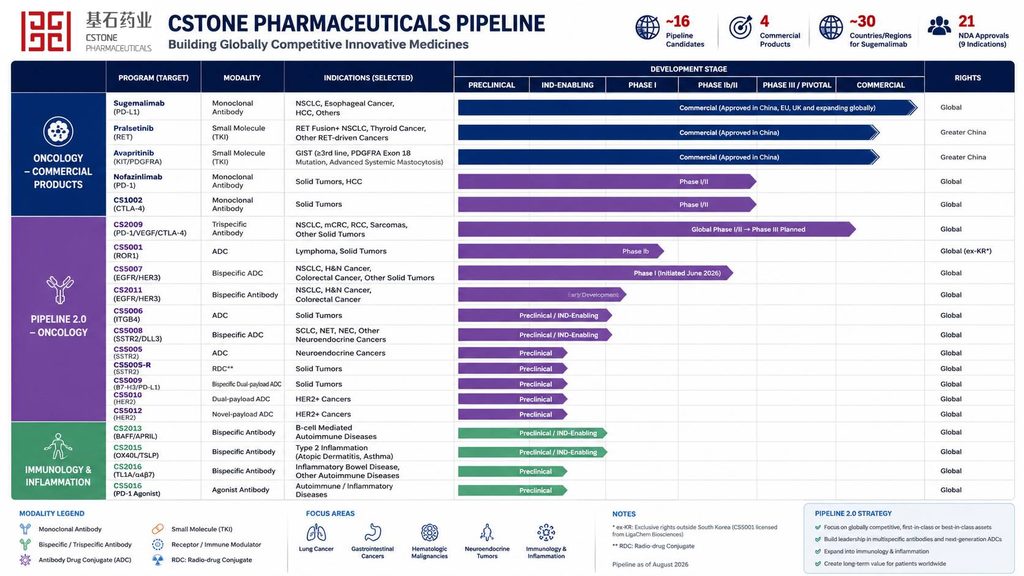
Commercial and Late-Stage Portfolio
| Drug | Target / modality | Major disease area | Current status |
|---|---|---|---|
| Sugemalimab (CEJEMLY) | PD-L1 antibody | NSCLC and other cancers | Marketed; China, EU, UK and expanding globally |
| Pralsetinib (GAVRETO) | RET inhibitor | RET-driven cancers | Marketed in China |
| Avapritinib (AYVAKIT) | KIT/PDGFRA inhibitor | GIST | Marketed in China |
| Nofazinlimab | PD-1 antibody | Solid tumors/HCC | Clinical development/partnering |
| CS1002 | CTLA-4 antibody | Solid tumors | Clinical development |
The most important wholly owned commercial asset is sugemalimab, CStone’s anti-PD-L1 antibody.
Pipeline 2.0
| Candidate | Modality / targets | Primary area | Approx. stage/status |
|---|---|---|---|
| CS2009 | PD-1/VEGF/CTLA-4 trispecific antibody | Multiple solid tumors | Global Phase I/II → Phase III planned |
| CS5001 | ROR1 ADC | Lymphoma + solid tumors | Phase Ib |
| CS5007 | EGFR/HER3 bispecific ADC | Solid tumors | Phase I |
| CS2011 | EGFR/HER3 bispecific antibody | NSCLC, H&N, CRC | Early development |
| CS5006 | ITGB4 ADC | Solid tumors | Preclinical/IND-enabling |
| CS5008 | SSTR2/DLL3 bispecific ADC | SCLC/NET/NEC | Preclinical/IND-enabling |
| CS5005 | SSTR2 ADC | Neuroendocrine cancers | Preclinical |
| CS5005-R | SSTR2 RDC | Solid tumors | Preclinical |
| CS5009 | B7-H3/PD-L1 bispecific dual-payload ADC | Solid tumors | Preclinical |
| CS5010 | HER2 dual-payload ADC | HER2 cancers | Preclinical |
| CS5012 | HER2 novel-payload ADC | HER2 cancers | Preclinical |
| CS2013 | BAFF/APRIL bispecific | B-cell autoimmune diseases | Preclinical/IND-enabling |
| CS2015 | OX40L/TSLP bispecific | Type 2 inflammation | Preclinical/IND-enabling |
| CS2016 | TL1A/α4β7 bispecific | Inflammatory/autoimmune diseases | Preclinical |
| CS1016 | PD-1 agonist | Autoimmune/inflammation | Preclinical |
The portfolio reflects a noticeable shift toward internally generated global assets, rather than relying primarily on Greater China licenses from Western biotech companies. (cstonepharma.com)
Lead Asset: CS2009
The asset that increasingly defines CStone’s investment and clinical story is CS2009, a PD-1/VEGF/CTLA-4 trispecific antibody.
Rather than administering separate PD-(L)1, VEGF and CTLA-4 agents, CS2009 attempts to integrate all three mechanisms within a single molecule.
By August 2026, more than 300 patients had been treated in the global Phase I/II program across China and Australia, and the U.S. FDA had cleared its IND in February 2026. (cstonepharma.com)
Latest CS2009 clinical signals
Updated August 2026 results included:
| Setting | CS2009 result |
|---|---|
| 1L NSCLC, PD-L1 ≥50%, 30 mg/kg | ORR 100%; DCR 100% |
| 1L NSCLC, PD-L1 ≥1%, 30 mg/kg | ORR 70.8%; DCR 91.7% |
| 2L NSCLC after IO + chemotherapy | ORR 38.5%; DCR 84.6% |
| Later-line mCRC, 30 mg/kg | ORR 20%; DCR 93.3% |
| Later-line soft-tissue sarcoma | ORR 38.5% |
| Later-line non-clear-cell RCC | ORR 42.9% |
| 1L mCRC + XELOX* | ORR 66.7%; DCR 100% |
*Small early cohort; results remain immature.
The company reported no dose-limiting toxicities across evaluated doses, and the maximum tolerated dose had not been reached. No new safety signal had emerged as of August 2026. (cstonepharma.com)
These are early, largely non-randomized results, so cross-trial comparisons with established PD-(L)1/VEGF or PD-(L)1/CTLA-4 regimens should be interpreted cautiously.
Phase III strategy
CStone plans to begin its first global Phase III MRCTs by the end of 2026, including:
First-line NSCLC
CS2009 + chemotherapy
vs. pembrolizumab + chemotherapy
First-line metastatic colorectal cancer
CS2009 + chemotherapy
vs. bevacizumab + chemotherapy
Additional registrational programs are expected from 2027 onward. (cstonepharma.com)
Another near-term catalyst is ESMO 2026, where CStone says CS2009 has been accepted for two Rapid Oral presentations covering NSCLC and metastatic colorectal cancer. (cstonepharma.com)
ADC Pipeline
ADCs represent the other major pillar of Pipeline 2.0.
CS5001 — ROR1 ADC
CS5001 originated from South Korea’s LigaChem Biosciences/ABL Bio collaboration. Under a 2020 license, CStone obtained exclusive development and commercialization rights outside South Korea. (cstonepharma.com)
The global Phase Ib program has explored CS5001 in lymphomas and solid tumors, including combinations with standard-of-care treatments such as R-CHOP in DLBCL.
CS5007 — EGFR/HER3 bispecific ADC
CS5007 is particularly noteworthy because it combines an EGFR/HER3 bispecific antibody with CStone’s proprietary ADC technology.
A global Phase I first-in-human trial began in June 2026, initially running in China and Australia in patients with advanced solid tumors. (cstonepharma.com)
The program potentially addresses tumors including NSCLC, head-and-neck squamous-cell carcinoma and colorectal cancer.
Next-generation ADC technology
CStone is also moving beyond conventional single-target/single-payload ADCs.
Its research portfolio now includes:
Bispecific ADCs: CS5007 and CS5008
Dual-payload ADCs: CS5009 and CS5010
Novel-payload ADCs: CS5012
The company presented preclinical results for CS5007, CS5006 and CS5008 at AACR 2026. (cstonepharma.com)
This ADC platform could become increasingly important if one or more of these programs demonstrate meaningful differentiation in humans.
Commercial Portfolio and Recent Developments
CEJEMLY — Sugemalimab
Sugemalimab is CStone’s most important internally developed commercial product and one of China’s more internationally advanced checkpoint inhibitors.
It is approved in China for multiple cancer indications and has also achieved regulatory approvals in Europe and the UK.
Notably, the EU subsequently approved sugemalimab for unresectable Stage III NSCLC, followed by UK MHRA approval in February 2026. (cstonepharma.com)
By August 2026, CStone said sugemalimab applications had been approved or were under active regulatory review in nearly 30 countries. (cstonepharma.com)
The company has deliberately adopted a partnership-based model rather than building a large commercial organization in every overseas market.
GAVRETO — Pralsetinib
Pralsetinib is a selective RET inhibitor originally licensed from Blueprint Medicines for Greater China.
Its inclusion in China’s National Reimbursement Drug List (NRDL) became effective January 1, 2026.
The effect on demand has been substantial: CStone reported that in-market sales volume increased almost 500% year over year during the first seven months of 2026. (cstonepharma.com)
CStone also began nationwide commercial distribution of locally manufactured pralsetinib in May 2026, reducing dependence on imported supply and potentially improving product economics. (cstonepharma.com)
AYVAKIT — Avapritinib
Avapritinib, another precision oncology medicine originally partnered with Blueprint Medicines, is approved in China for GIST.
Domestic supply began in February 2025 following approval of localized manufacturing, while the product successfully retained NRDL coverage in late 2025. (cstonepharma.com)
Partnerships and Licensing
Partnerships have been central to CStone’s business model since its creation.
Major ongoing relationships
| Partner | Asset | Nature of relationship |
|---|---|---|
| LigaChem Biosciences | CS5001 | CStone holds development/commercial rights outside South Korea |
| Blueprint Medicines | Pralsetinib / avapritinib | Greater China licensing relationship |
| Ewopharma | Sugemalimab | Central/Eastern Europe + Switzerland commercialization |
| Pharmalink | Sugemalimab | Middle East, North Africa + South Africa |
| SteinCares | Sugemalimab | Latin America |
| Istituto Gentili | Sugemalimab | Western Europe + UK |
| Arrotex Pharmaceuticals | Sugemalimab | Australia + New Zealand |
Sugemalimab has therefore become the clearest example of CStone’s regional-partner global commercialization strategy.
The five international commercialization partnerships now cover more than 60 countries and regions. (cstonepharma.com)
Gentili agreement
The July 2025 deal with Italy’s Istituto Gentili is particularly significant. CStone is eligible for up to US$192.5 million in upfront, regulatory and commercial milestone payments and expects to recognize close to 50% of net sales in licensed territories as revenue. (webmgr.cstonepharma.com)
Ewopharma
The earlier Ewopharma deal covers Switzerland and 18 Central and Eastern European countries. CStone disclosed potential consideration of up to US$51.3 million, consisting of upfront and milestone-related payments. (cstonepharma.com)
Arrotex
In June 2026, CStone added Australia and New Zealand through an exclusive agreement with Arrotex. CStone receives an upfront payment, is eligible for regulatory/commercial milestones, supplies the product and participates through a profit-sharing arrangement. (cstonepharma.com)
Financing and Financial Position
CStone has historically raised substantial venture financing, IPO capital, partnership payments and, more recently, additional public-equity capital.
Its early private financing included approximately:
Series A: US$150 million
Series B: US$262 million (cstonepharma.com)
More recently, the company strengthened its balance sheet through a share placement.
On April 22, 2026, CStone completed the placement of 118 million new shares at HK$8.97 per share, implying gross proceeds of approximately HK$1.06 billion before expenses. (hkexnews.hk)
That financing contributed to a substantial increase in liquidity:
| Financial metric | Amount |
|---|---|
| Cash + time deposits, Dec. 31, 2025 | RMB 918.7M |
| Cash + time deposits, June 30, 2026 | RMB 1.560B |
| FY2025 revenue | RMB 269.6M |
| H1 2026 revenue | RMB 205.1M |
(cstonepharma.com, cstonepharma.com)
The roughly RMB 1.56 billion cash position gives CStone a substantially stronger financial base as it prepares to move CS2009 into expensive multinational Phase III trials and advances multiple ADC programs into human testing.
Latest Developments and Near-Term Catalysts
As of August 2026, CStone appears to be entering an important transition from a China-focused oncology biotech with licensed commercial products toward a company attempting to create globally competitive proprietary medicines.
The most important developments to watch are:
- CS2009 at ESMO 2026 — updated Phase I/II NSCLC and mCRC data through two Rapid Oral presentations.
- CS2009 global Phase III initiation — first registrational MRCTs targeted to start by year-end 2026.
- CS2009 partnering — CStone explicitly continues to seek global partnerships for the program. (cstonepharma.com)
- CS5007 Phase I — first human validation of an important ADC generated from CStone’s proprietary platform.
- CS5006/CS5008 clinical entry — additional ADC candidates are expected to move toward clinical development.
- Sugemalimab international launches — expansion across the >60-country footprint established through regional partners.
- Pralsetinib growth in China — NRDL reimbursement and local manufacturing could continue driving volume growth.
Assessment
CStone today is quite different from the company that went public in 2019. Its original model relied substantially on bringing externally sourced precision medicines into China while developing sugemalimab and other immunotherapies. The company’s future value proposition increasingly rests on Pipeline 2.0.
Within that portfolio, CS2009 is clearly the pivotal asset. Its early efficacy in first-line NSCLC, immunotherapy-resistant NSCLC and traditionally immunologically “cold” tumors such as MSS colorectal cancer has created a plausible route toward multiple global registrational programs. However, the evidence remains early, and randomized Phase III trials will ultimately determine whether its encouraging response rates translate into clinically meaningful PFS and OS advantages.
Behind CS2009, CStone is assembling a relatively broad ADC franchise around CS5001, CS5007, CS5006, CS5008, CS5009, CS5010 and CS5012, while its expansion into OX40L/TSLP, BAFF/APRIL and TL1A/α4β7 biology gives the company an emerging immunology/inflammation portfolio.
Commercially, meanwhile, CStone has chosen an increasingly capital-efficient partnership model: retain innovation and product economics while relying on established regional companies to commercialize sugemalimab internationally.
Combined with the April 2026 equity financing and RMB1.56 billion cash position, CStone enters the second half of 2026 with a considerably stronger balance sheet to support its transition toward global Phase III development.
Key sources
CStone — Company Profile
CStone — 2026 Interim Results, August 27, 2026
CStone — Corporate Milestones
CStone — 2025 Annual Results
CStone — CS2009 ASCO 2026 Clinical Update
CStone — CS5007 Global Phase I Initiation
HKEX — CStone April 2026 Share Placement
CStone — Arrotex/Sugemalimab Partnership
CStone — Gentili/Sugemalimab Partnership
CStone — Business Development