Chinese AI-driven drug discovery startup AIPher has completed an angel financing round of approximately RMB 100 million (about $14 million+), an unusually large early-stage raise completed just over a month after the company was established.
The financing was led by Xiang He Capital, with participation from Xinglian Capital, an investment platform affiliated with Zhipu AI, and an unnamed industry fund, according to Chinese media reports. AIPher was established in July 2026 and is headquartered in Beijing’s Haidian District. (Sina Finance)
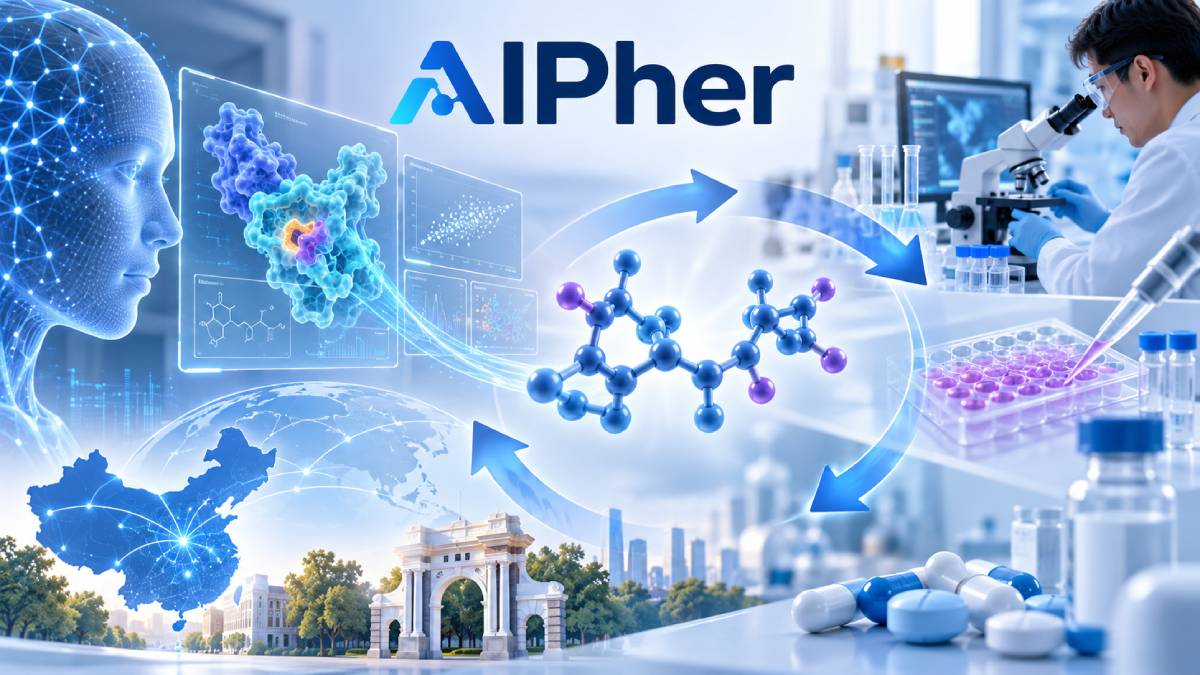
The proceeds will be used to further develop AIPher’s AI drug discovery technologies, including its DrugCLIP foundation model and PharmAgents AI agent system, establish an integrated computational and experimental drug-discovery platform, and advance both proprietary and partnered drug programs. (CNR)
The financing stands out not only for its size but also for its speed: the company went from incorporation to completing its first institutional financing in just over one month. (Eastmoney Finance)
From Tsinghua AI Research to Drug Discovery
AIPher describes itself as an “AI Native” drug R&D company, rather than a conventional biotechnology company simply adding machine learning tools to existing discovery workflows.
Its technological roots can be traced to research conducted at Tsinghua University, particularly the university’s Institute for AI Industry Research (AIR) and related computer-science research teams. (CNR)
The company’s leadership reflects those academic origins.
Bowen Gao, a doctoral researcher in computer science at Tsinghua AIR, serves as CEO. Professor Yanyan Lan, deputy dean and chief researcher at Tsinghua AIR, serves as AIPher’s chief scientist, while Ya-Qin Zhang, Tsinghua professor and founding dean of AIR, serves as chief scientific advisor. (Eastmoney Finance)
The underlying research team has reportedly been working systematically on AI-based drug discovery since around 2021, generating more than 30 research papers across venues including NeurIPS, ICLR and ICML as well as Nature, Science and related journals. (Sina Tech)
That research is now being translated from academia into a commercial drug-development organization.
DrugCLIP: Exploring Chemical Space With AI
A core component of AIPher’s technology platform is DrugCLIP, an AI-based virtual screening framework designed to identify molecules capable of interacting with disease-associated protein targets.
Research underlying DrugCLIP was published in Science, and the platform has been applied to large-scale virtual screening across human protein targets. (CNR)
The technology is intended to allow AI models to explore enormous chemical spaces much more efficiently than conventional computational screening approaches.
But AIPher’s ambition goes beyond using AI merely to rank compounds.
The company is developing a broader system in which AI participates in scientific decision-making throughout the drug discovery process, including identifying what experiments should be performed next and incorporating experimental results back into subsequent rounds of modeling. (CNR)
PharmAgents: Giving AI a Larger Role in Drug R&D
That strategy is embodied in AIPher’s second major technology platform, PharmAgents.
Rather than functioning as a single predictive model, PharmAgents is designed as an AI-agent system capable of integrating scientific evidence, specialized models and experimental information to help plan and make decisions across drug discovery workflows. (CNR)
AIPher ultimately envisions a closed-loop system:
AI exploration → R&D decision → experimental validation → data generation → AI learning → next experiment.
Experimental successes and failures can therefore become new training signals for the models and agents, potentially creating a proprietary data flywheel as more discovery programs move through the platform. (Sina Tech)
This represents an important distinction between AIPher’s approach and many earlier AI drug-discovery models.
Rather than inserting an AI prediction tool into one step of conventional pharmaceutical R&D, the company wants AI to become part of the underlying drug-discovery operating system.
First Proprietary Program Already Reaches Pre-PCC Stage
Despite AIPher’s extremely recent incorporation, its academic predecessor team had already been working on real drug-discovery projects before the company was formally established.
The company’s most advanced first-in-class (FIC) program has already reached the Pre-PCC stage, meaning it is approaching selection of a preclinical candidate compound. (CNR)
One program described publicly involves NET (norepinephrine transporter) in attention-deficit/hyperactivity disorder (ADHD).
During earlier academic work, the team used AI to identify a previously unreported binding pocket on NET. The company believes the site could potentially enable greater selectivity and allosteric effects, creating opportunities to differentiate future drug candidates from existing therapies. The resulting program has reportedly progressed toward preclinical candidate selection. (Sina Tech)
This is particularly important for an AI drug company because the industry’s ultimate test is not whether an algorithm can generate molecules, but whether those molecules can become validated pharmaceutical assets.
Moving Beyond “AI-as-a-Service”
AIPher’s commercial strategy may be as important as its underlying technology.
Many early AI drug-discovery companies adopted a service-oriented business model: pharmaceutical companies supplied a target or discovery problem, the AI company performed computational work, and the pharma partner paid a service fee.
AIPher intends to move beyond that model.
CEO Bowen Gao has indicated that the company does not want its primary business to consist of collecting one-time technology-service fees. Instead, AIPher plans to pursue co-development relationships in which it retains economic interests in the resulting drug assets. (Sina Tech)
Potential economics could therefore include:
- R&D milestone payments;
- downstream licensing or license-out transactions;
- product-related revenue sharing or royalties; and
- retained rights in jointly developed drug assets.
In other words, AIPher’s objective is not simply to monetize its algorithms. It wants to monetize the medicines created using those algorithms.
That places the company closer to an AI-native biotech than a conventional software provider.
Partnerships Already Underway
AIPher is pursuing the strategy alongside its internally owned pipeline.
The company says it has already established co-development projects with more than five pharmaceutical and biotech companies, covering areas including metabolic disease, central nervous system disorders, autoimmune diseases and drug delivery. (CNR)
The collaborations span different drug modalities, including small molecules and peptides, as well as target discovery and reverse target identification.
More broadly, the founding team’s research network has reportedly established more than 30 collaborations involving pharmaceutical companies, hospitals, universities and research institutes, providing opportunities to test AI-generated discoveries against real experimental data. (Sina Tech)
The Tsinghua ecosystem has also been strengthening its links with global pharma. In March 2026, Tsinghua AIR and AstraZeneca announced an AI drug R&D joint research center focused on areas including AI-driven molecular research, translational medicine and clinical development. (Sina Tech)
A New Generation of Chinese AI Biotech
AIPher’s rapid financing comes as China’s AI drug-discovery sector enters a new stage.
The first generation of AI-biotech companies largely focused on demonstrating that machine learning could accelerate individual stages of drug discovery, such as protein-structure prediction, molecular generation and virtual screening.
The next question is substantially harder: Can AI consistently generate differentiated molecules that become clinically and commercially valuable medicines?
AIPher is effectively betting that the answer will require AI to participate throughout the discovery process rather than remain an isolated computational tool.
Its model therefore combines three elements: AI foundation models, autonomous or semi-autonomous scientific agents, and continuous experimental feedback.
If that architecture succeeds, AI could do more than shorten individual discovery tasks. It could potentially allow a relatively small biotechnology organization to run programs across multiple targets, therapeutic areas and drug modalities without building a traditional dedicated team around every individual asset.
That remains to be demonstrated clinically. AIPher is still an exceptionally young company, and its most advanced internal program remains preclinical.
Nevertheless, raising approximately RMB 100 million within weeks of incorporation, while already bringing academic AI technology into proprietary and partnered drug programs, makes AIPher a notable new entrant in China’s increasingly competitive AI-for-drug-discovery landscape. (CNR)
References
- CNR (央广网), September 3, 2026 — AIPher Completes RMB 100 Million Angel Financing. Reports the investors, intended use of proceeds, DrugCLIP and PharmAgents platforms, Pre-PCC program and co-development strategy.
Read the CNR report - Sina Technology, September 3, 2026 — AIPher Raises RMB 100 Million One Month After Formation. Details the financing, Tsinghua AIR origins, investors and existing pharma/Biotech collaborations.
Read the Sina Technology report - STAR Market Daily / Eastmoney, September 3, 2026 — AIPher Completes Angel Financing Led by Xiang He Capital. Provides company incorporation, location, financing and founding-team information.
Read the report - ChinaVenture / Sina Finance, September 3, 2026 — Tsinghua PhD Bowen Gao Enters AI Drug Discovery. Provides an extensive account of AIPher’s founding team, DrugCLIP, PharmAgents, internal pipeline, AI-native development philosophy and co-development business model.
Read the ChinaVenture/Sina report - PEDaily / 投资界, September 3, 2026 — AIPher Builds an AI-Native Drug Discovery Company. Discusses the financing and the company’s technology architecture, including DrugCLIP and PharmAgents.
Read the PEDaily report