TYK Medicines Wins China Approval for Asandeutertinib in EGFR-Mutant NSCLC With Brain Metastases
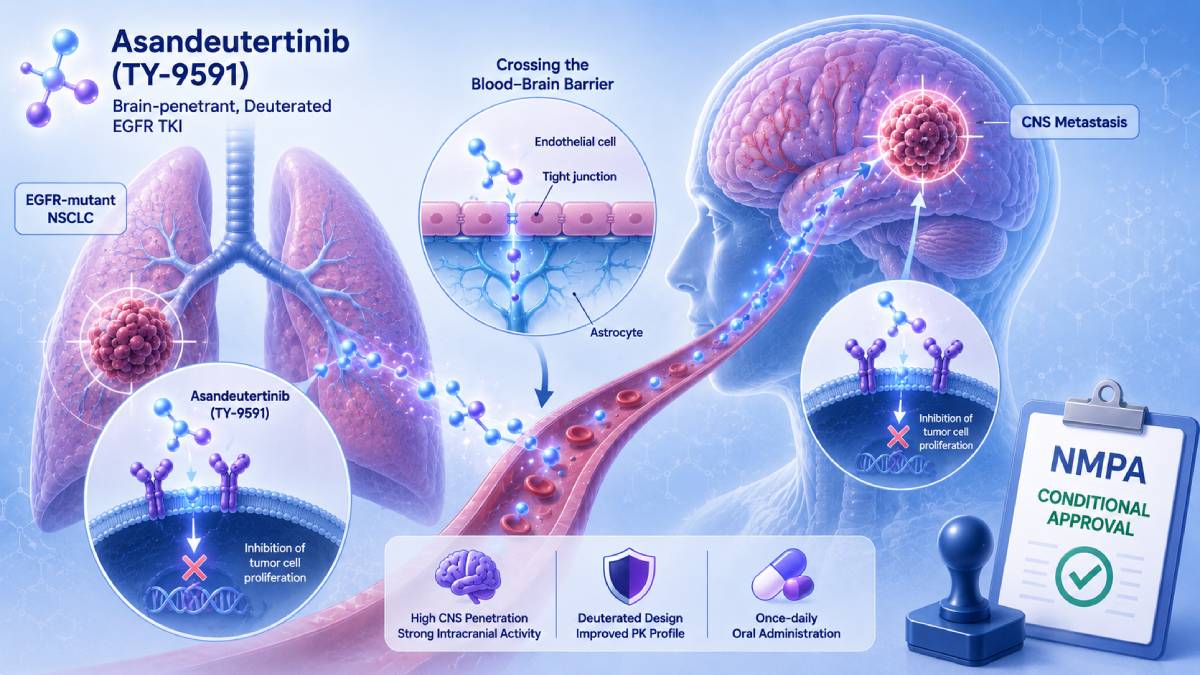
China’s NMPA has granted conditional approval to asandeutertinib (TY-9591), TYK Medicines’ brain-penetrant, deuterated EGFR inhibitor, for the first-line treatment of patients with EGFR-mutated non-small cell lung cancer with central nervous system metastases.
The approval announced August 27 represents a major milestone for TYK Medicines (HKEX: 2410) and introduces a new domestically developed targeted therapy specifically for one of the most difficult-to-treat populations in EGFR-mutant lung cancer. (finance.sina.com.cn, prnasia.com)
China’s National Medical Products Administration conditionally approved asandeutertinib mesylate tablets (TY-9591) for first-line treatment of adults with locally advanced or metastatic NSCLC harboring an EGFR exon 19 deletion or exon 21 L858R substitution mutation and CNS metastases. (prnasia.com)
The regulatory decision was supported by the pivotal Phase II ESAONA study, which directly compared asandeutertinib against osimertinib in previously untreated EGFR-mutant NSCLC patients with brain metastases.
Approval at a Glance
| Item | Details |
|---|---|
| Drug | Asandeutertinib mesylate (TY-9591) |
| Developer | TYK Medicines |
| Modality | Oral third-generation EGFR TKI |
| Design | Deuterated analogue of osimertinib |
| Regulatory status | Conditionally approved by China NMPA |
| Approval date | August 27, 2026 |
| Treatment line | First-line |
| EGFR mutations | Exon 19 deletion or exon 21 L858R |
| Population | Locally advanced/metastatic NSCLC with CNS metastases |
| Registrational study | ESAONA Phase II |
| Comparator | Osimertinib |
| Key differentiation | High CNS penetration and intracranial efficacy |
A Head-to-Head Challenge to Osimertinib
The approval is notable because ESAONA did not compare TY-9591 against chemotherapy or placebo.
It directly challenged osimertinib, the established third-generation EGFR TKI standard.
ESAONA (NCT05948813) is an open-label, multicenter, randomized pivotal Phase II study enrolling previously untreated patients with EGFR exon 19 deletion or L858R-mutated NSCLC and stable brain metastases.
Patients were randomized 1:1 to receive:
Asandeutertinib: 160 mg orally once daily
Osimertinib: 80 mg orally once daily
Randomization was stratified by EGFR mutation type and number of intracranial lesions. The co-primary endpoints were intracranial objective response rate (iORR) and intracranial progression-free survival (iPFS) assessed by blinded independent central review. (tykmedicines.com)
A total of 224 patients were included in the key randomized analysis—111 receiving asandeutertinib and 113 receiving osimertinib. (doi.org)
Asandeutertinib Delivers 95.5% Intracranial Response Rate
The most mature ESAONA results were presented as a late-breaking oral abstract at the 2026 ASCO Annual Meeting.
Asandeutertinib produced a confirmed BICR-assessed intracranial objective response rate of:
95.5% with asandeutertinib vs 79.6% with osimertinib
The difference was statistically significant at P=0.0004. (asco.org)
Complete intracranial responses occurred in 13.5% of asandeutertinib-treated patients versus 11.5% receiving osimertinib. (onclive.com)
| ESAONA efficacy measure | Asandeutertinib | Osimertinib |
|---|---|---|
| BICR intracranial ORR | 95.5% | 79.6% |
| Intracranial complete response | 13.5% | 11.5% |
| Median intracranial PFS | Not reached | 17.51 months |
| iPFS hazard ratio | 0.46 | Reference |
| Investigator iORR | 92.8% | 77.9% |
| Systemic ORR | 89.2% | 77.9% |
| Median systemic PFS | Not reached | 17.22 months |
The intracranial response advantage was therefore accompanied by evidence that the responses lasted longer.
54% Reduction in Risk of Intracranial Progression or Death
The second co-primary endpoint also favored asandeutertinib.
Median intracranial PFS by BICR had not yet been reached with asandeutertinib compared with 17.51 months for osimertinib.
The hazard ratio was 0.46 (95% CI 0.28–0.76; P=0.0020), corresponding to a 54% reduction in the risk of intracranial progression or death. (doi.org, onclive.com)
The benefit was generally consistent across prespecified subgroups, including EGFR mutation type and intracranial disease burden. (onclive.com)
The latest reported 18- and 24-month intracranial PFS rates with asandeutertinib were 75.24% and 61.56%, respectively. (m.hk.investing.com)
These findings are particularly important because CNS progression remains a major clinical problem even in the era of brain-penetrant third-generation EGFR inhibitors.
Systemic Disease Control Also Favors TY-9591
The advantage was not confined to brain lesions.
BICR-assessed systemic objective response rate was 89.2% with asandeutertinib versus 77.9% with osimertinib in the latest dataset. (financialfilings.com)
Median systemic PFS had not been reached for asandeutertinib compared with 17.22 months for osimertinib.
The PFS hazard ratio was 0.64, indicating a 36% reduction in the risk of progression or death, although follow-up remains relatively immature. (doi.org)
Overall survival data are also not yet mature.
The combination of higher intracranial response, prolonged intracranial disease control and numerically stronger systemic activity provides the clinical rationale behind the conditional approval.
Why Brain Metastases Matter in EGFR-Mutant NSCLC
Brain metastases are particularly important in EGFR-mutant lung cancer because patients can survive for years on modern targeted therapies, increasing the clinical importance of long-term CNS disease control.
The blood-brain barrier also limits CNS exposure for many systemic medicines.
Osimertinib substantially improved this situation because it penetrates the CNS more effectively than earlier EGFR inhibitors. Nevertheless, intracranial progression still occurs.
TYK Medicines therefore designed asandeutertinib with CNS activity as a central development objective rather than treating brain metastases as a secondary subgroup analysis.
The company’s regulatory strategy reflected this distinction: ESAONA specifically enrolled patients with brain metastases and incorporated intracranial response and intracranial PFS as primary endpoints. (tykmedicines.com)
That makes the resulting approval unusually targeted to this high-risk patient population.
What Is Asandeutertinib?
Asandeutertinib is a highly potent, ATP-competitive, irreversible, oral third-generation EGFR TKI developed internally by TYK Medicines.
It selectively targets classical EGFR sensitizing mutations, including exon 19 deletion and L858R, as well as the T790M resistance mutation. (asco.org, hkexnews.hk)
What differentiates the molecule chemically is deuteration.
Asandeutertinib is a deuterated analogue of osimertinib. Selected hydrogen atoms in the molecular structure are replaced by deuterium, a stable isotope of hydrogen.
This apparently small chemical change can alter how quickly particular molecular bonds are metabolized.
TYK Medicines designed the molecule to produce a differentiated pharmacokinetic profile while substantially reducing formation of the active metabolite AZ5104/TY9591-D1, which the company associates with off-target toxicity. (hkexnews.hk)
The company also reports high bioavailability and enhanced brain penetration. (hkexnews.hk)
Earlier Studies Established the CNS Signal
The strong ESAONA results were preceded by encouraging early clinical findings.
In an earlier Phase II study involving 29 patients with EGFR-mutant NSCLC and brain metastases, investigator-assessed confirmed intracranial ORR reached 93.1%.
Among the 27 previously untreated patients, intracranial ORR was 92.6%, while 12-month intracranial PFS was 96.6%. (asco.org)
The Phase I program also demonstrated activity in first-line EGFR-mutant NSCLC.
Among 79 patients in dose expansion, median PFS was 21.5 months, while confirmed ORR was 85.9%. In the L858R subgroup, median PFS was 19.3 months and ORR reached 86.1%. (sciencedirect.com)
Those findings encouraged TYK Medicines to pursue a dedicated registrational strategy in patients with brain metastases.
Safety Remains an Important Part of the Comparison
Asandeutertinib’s efficacy advantage must be considered alongside its toxicity profile.
In the mature ESAONA analysis, treatment-related adverse events occurred in 99.1% of patients receiving asandeutertinib and 95.6% receiving osimertinib. Treatment-related serious adverse events occurred in 10.8% and 7.1%, respectively. (doi.org)
Grade 3 treatment-related adverse events were reported in 43.2% of asandeutertinib patients versus 15.9% of osimertinib patients. The most common Grade 3 events with asandeutertinib included decreases in neutrophils, white blood cells and lymphocytes as well as elevated creatine phosphokinase. (financialfilings.com)
Interstitial lung disease was reported in 6.3% of asandeutertinib-treated patients and QTcF prolongation in 4.5%, according to TYK Medicines’ latest interim report. The company characterized these events as manageable. (financialfilings.com)
Thus, while the intracranial efficacy comparison clearly favors TY-9591 in ESAONA, the overall benefit-risk comparison with osimertinib will need to account for the higher incidence of Grade 3 treatment-related toxicity.
Conditional Approval Followed Priority Review
TYK Medicines formally submitted the conditional NDA in December 2025.
China’s Center for Drug Evaluation subsequently placed asandeutertinib into the Priority Review pathway in January 2026, and the NDA was formally accepted in February. (www1.hkexnews.hk, financialfilings.com)
The conditional approval arrived on August 27, 2026, roughly six months after formal NDA acceptance.
The regulatory strategy allowed the initial 224-patient randomized ESAONA cohort to support conditional approval while enrollment and follow-up continued to generate the evidence required for full approval. By June 2026, the broader ESAONA program had enrolled 383 patients. (financialfilings.com)
Continued confirmatory evidence will therefore be important for converting the conditional authorization into full marketing approval.
A Broader Development Program Is Already Underway
TYK Medicines is not limiting asandeutertinib to CNS-metastatic disease.
A separate registrational Phase III study is evaluating TY-9591 monotherapy as first-line treatment specifically in patients with EGFR L858R-mutated locally advanced or metastatic NSCLC.
Enrollment had reached 548 patients by April 2026, with the company targeting completion during the fourth quarter of 2026 and an NDA submission in 2028. (financialfilings.com)
TYK Medicines is also studying asandeutertinib in combination with pemetrexed plus cisplatin or carboplatin as first-line therapy for advanced EGFR-mutant NSCLC.
The strategy could eventually expand TY-9591 from its initial CNS-metastatic niche into a substantially broader first-line EGFR-mutant NSCLC franchise.
Commercialization Partnership With Qilu Pharmaceutical
Commercialization is also taking shape.
In July 2026, TYK Medicines entered a transaction with Qilu Pharmaceutical involving TY-9591. TYK subsequently disclosed receipt of RMB700 million in upfront consideration, including RMB400 million associated with an equity subscription. (eeo.com.cn)
The partnership provides TYK Medicines with the support of one of China’s largest domestic pharmaceutical companies as asandeutertinib moves from clinical development into commercialization.
That timing is particularly important now that conditional NMPA approval has been secured.
A Differentiated Challenge to an Established Standard
Asandeutertinib enters a highly competitive market.
Osimertinib has established itself as one of the most important targeted therapies in lung cancer and already possesses strong CNS activity.
TYK Medicines therefore faced a high bar: simply demonstrating that another third-generation EGFR inhibitor works would offer limited differentiation.
ESAONA instead pursued one of the clearest possible tests—a randomized head-to-head study against osimertinib in patients who already had brain metastases.
The results produced a compelling intracranial efficacy signal.
BICR-assessed iORR reached 95.5% versus 79.6%, while the hazard of intracranial progression or death was reduced by 54%. (doi.org)
The systemic efficacy signal also favored TY-9591, although those data remain less mature.
At the same time, the higher rate of Grade 3 treatment-related adverse events means the clinical differentiation is not purely one-sided. Longer follow-up, overall survival, quality-of-life data and real-world experience will ultimately help determine how clinicians weigh stronger intracranial efficacy against toxicity.
Outlook
The conditional approval of asandeutertinib represents a significant milestone for TYK Medicines.
Founded in 2017, the company has advanced TY-9591 from discovery to its first commercial approval in less than a decade. (hkexnews.hk)
More importantly, the drug has entered the market with an unusually clear clinical positioning: first-line treatment of EGFR exon 19 deletion/L858R NSCLC with CNS metastases.
Rather than attempting initially to compete across the entire first-line EGFR-mutant population, TYK Medicines has focused on a subgroup where better brain penetration and intracranial disease control could provide meaningful differentiation.
ESAONA provides strong evidence supporting that strategy. The latest randomized data show both a significantly higher intracranial response rate and substantially prolonged intracranial PFS compared with osimertinib. (doi.org)
The next questions are whether that intracranial advantage translates into a meaningful overall-survival benefit, how the safety profile performs in broader real-world use, and whether TY-9591 can replicate its success in the much larger EGFR-mutant NSCLC population without baseline CNS metastases.
For now, however, the August 27 approval establishes asandeutertinib as an important new entrant in China’s increasingly competitive EGFR-targeted therapy market—and one specifically designed to address one of the remaining weaknesses of targeted lung cancer treatment: durable control of disease inside the brain.
References
- TYK Medicines – Official Website
- TYK Medicines – Asandeutertinib Conditional Approval Announcement
- ASCO – ESAONA Phase II Results
- Journal of Clinical Oncology – ESAONA LBA2007
- TYK Medicines – ESAONA Study and Asandeutertinib Overview
- TYK Medicines – 2026 Interim Report and TY-9591 Development Program
- Journal of Thoracic Oncology – Phase I Study of Asandeutertinib
- ASCO – Earlier Phase II CNS Study of TY-9591
- Hong Kong Stock Exchange – TY-9591 NDA Acceptance
- OncLive – ESAONA CNS Efficacy Analysis