LaNova Medicines’ Next-Generation Nectin-4 ADC LM-364 Wins China IND Clearance for Advanced Solid Tumors
LaNova Medicines has received clearance from China’s National Medical Products Administration (NMPA) to advance LM-364, its next-generation tumor microenvironment-responsive Nectin-4 antibody-drug conjugate (ADC), into clinical development for patients with advanced solid tumors.
China’s Center for Drug Evaluation (CDE) database showed the clinical trial application for LM-364 as approved on August 24, 2026. The regulatory milestone was subsequently formally announced on August 28 by LaNova’s parent company, Sino Biopharmaceutical (HKEX: 1177). (pharnexcloud.com)
The Chinese clearance adds another major regulatory market to LM-364’s global development program. The candidate had already received U.S. FDA clearance to enter clinical trials in April 2026, while clinical development has also been initiated in Australia. (itiger.com)
A Tumor-Activated Approach to Nectin-4
LM-364 is designed to tackle one of the central challenges facing Nectin-4-directed ADCs: distinguishing tumor-associated Nectin-4 from the same target expressed at lower levels in healthy tissues.
Nectin-4 has emerged as a clinically validated ADC target and is overexpressed in multiple malignancies, including urothelial carcinoma, triple-negative breast cancer (TNBC), cervical cancer, non-small cell lung cancer (NSCLC), and head and neck squamous cell carcinoma (HNSCC). However, Nectin-4 is also expressed in certain normal tissues, contributing to toxicities such as skin reactions and peripheral neuropathy associated with Nectin-4-directed therapies. (www1.hkexnews.hk)
LaNova is attempting to improve this therapeutic window through a different approach.
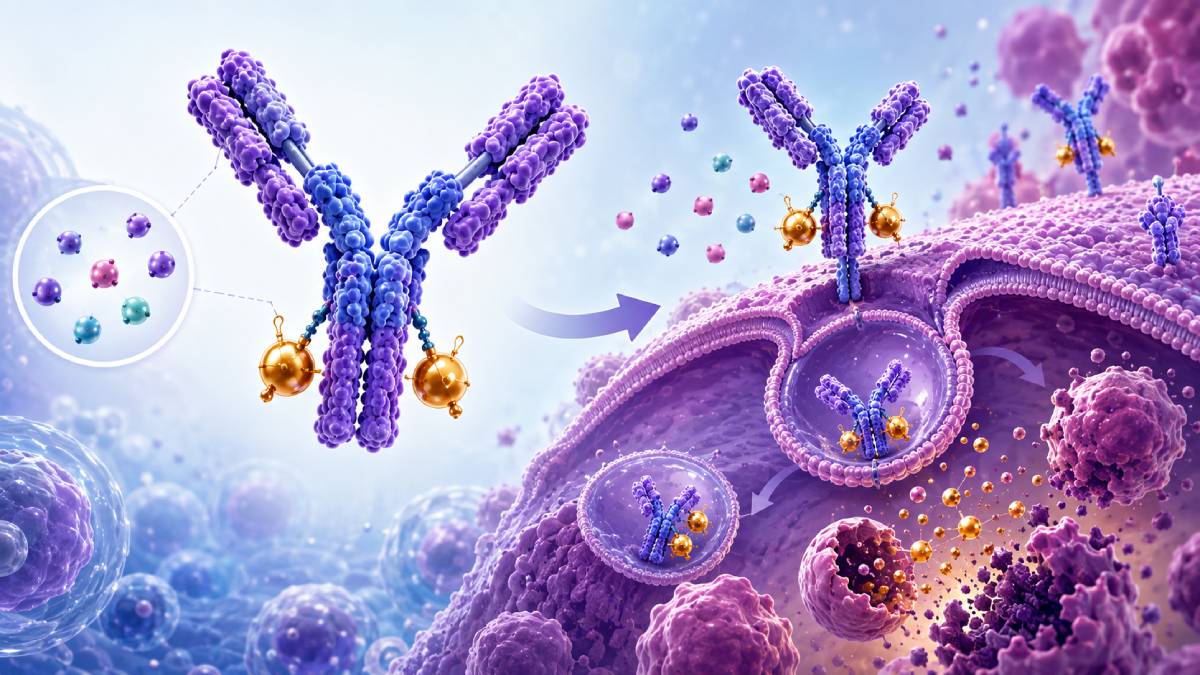
LM-364 was developed using the company’s proprietary tumor microenvironment (TME)-responsive ADC platform. Rather than maintaining equally strong target binding throughout the body, LM-364 is engineered to become a high-affinity Nectin-4 binder preferentially within the tumor microenvironment. (en.sbpgroup.com)
The key is an adenine nucleotide-dependent binding mechanism.
According to preclinical research presented by LaNova at the AACR Annual Meeting 2026, adenine nucleotide concentrations are substantially higher in the tumor microenvironment—at micromolar levels—than in normal tissues, where concentrations are generally at nanomolar levels.
LM-364 exploits this difference to achieve conditionally activated, high-affinity Nectin-4 binding within tumors, potentially increasing ADC internalization and payload delivery while reducing binding to Nectin-4 expressed by healthy tissues. (www1.hkexnews.hk)
In principle, this strategy could address the classic ADC problem of “on-target, off-tumor” toxicity and thereby broaden LM-364’s therapeutic window.
Strong Preclinical Antitumor Activity
Preclinical results presented at AACR 2026 provided early evidence supporting the concept.
Under high adenine nucleotide conditions designed to mimic the tumor microenvironment, LM-364 demonstrated strong Nectin-4 binding, efficient internalization, potent tumor-cell cytotoxicity and a bystander effect. In the absence of adenine nucleotides, target binding was negligible, creating a substantial conditional-binding window. (aacrjournals.org)
LM-364 also produced pronounced tumor growth inhibition across multiple preclinical models:
| Tumor model | Tumor growth inhibition (TGI) |
|---|---|
| Triple-negative breast cancer | 119.1% |
| Urothelial carcinoma | 107.46% |
| Cervical cancer | 168.79% |
| Esophageal cancer | 86.73% |
Tumor growth inhibition exceeding 100% in these models reflects tumor regression relative to baseline rather than merely slowed tumor growth.
Importantly, LaNova also reported encouraging toxicology findings. LM-364 was well tolerated in repeat-dose studies in rats and rhesus monkeys, with a highest non-severely toxic dose (HNSTD) of 60 mg/kg in monkeys, supporting progression into human clinical testing. (en.sbpgroup.com)
LM-364 Moves Into First-in-Human Development
LM-364’s first-in-human development program is designed to evaluate the ADC both as a single agent and in combination with anti-tumor therapy in patients with advanced solid tumors.
A registered Phase I/II study, NCT07694765, plans to evaluate LM-364 alone and in combination with the PD-1 antibody tislelizumab. The study has an estimated enrollment of approximately 90 patients. (trialant.com)
The Phase I portion is designed primarily to characterize safety, tolerability, pharmacokinetics and immunogenicity and to establish parameters such as the maximum tolerated dose (MTD), optimal biologic dose (OBD), and/or recommended Phase II dose (RP2D).
The Phase II portion will then assess preliminary antitumor activity in patients with advanced solid tumors. (trialant.com)
The trial represents an important test of whether the striking tumor-versus-normal-tissue selectivity demonstrated in LM-364’s preclinical experiments can translate into humans.
Why LM-364 Matters
Nectin-4 is no longer an experimental ADC target—the clinical success of the class has already validated it as an important therapeutic target in oncology. The next challenge is therefore less about proving that Nectin-4 works and more about improving the therapeutic index of Nectin-4-targeted ADCs.
That is where LM-364 could potentially differentiate itself.
Instead of simply optimizing the antibody, linker or cytotoxic payload, LaNova is attempting to make the ADC’s target-binding behavior dependent on the biochemical characteristics of the tumor microenvironment.
If successful clinically, the strategy could allow stronger antitumor activity at tolerable doses while reducing target-mediated toxicity in healthy tissues.
The approach also highlights a broader trend in China’s increasingly competitive ADC sector: developers are moving beyond conventional target-plus-payload combinations toward conditionally active ADCs, bispecific ADCs, novel payloads and other technologies designed to improve tumor selectivity and therapeutic index.
For LaNova, LM-364 also adds another potentially differentiated program to an oncology pipeline already spanning ADCs, bispecific antibodies and other tumor-microenvironment-focused therapeutics.
A Growing Global Program
LM-364’s Chinese IND clearance is particularly notable because development is already extending beyond China.
The candidate received U.S. FDA clinical-trial clearance in April 2026, and LaNova has initiated clinical development in Australia. With the NMPA clearance, the company can now advance LM-364 across multiple major regulatory jurisdictions as part of a broader global development strategy. (en.sbpgroup.com)
The program remains early-stage, and the impressive efficacy and safety findings observed in animal models will need to be confirmed in patients. Nevertheless, LM-364 represents an intriguing test of whether tumor-microenvironment-dependent ADC activation can materially widen the therapeutic window of an already clinically validated ADC target.
Early human safety, pharmacokinetic and efficacy data will therefore be closely watched—not only for LM-364 itself, but also as a proof of concept for the broader generation of conditionally active ADC technologies emerging from China’s biotech industry.
References
- Sino Biopharmaceutical — LM-364 “Nectin-4 TME ADC” clinical trial application approved by NMPA and FDA
- Sino Biopharmaceutical — LaNova Medicines presents LM-364 and LM-338 data at AACR 2026
- AACR / Cancer Research — Preclinical evaluation of LM-364TME, a next-generation anti-Nectin-4 ADC
- HKEX — LaNova Medicines presents latest research data on two ADC programs at AACR 2026
- LaNova Medicines — Pipeline
- LM-364 Phase I/II study — NCT07694765